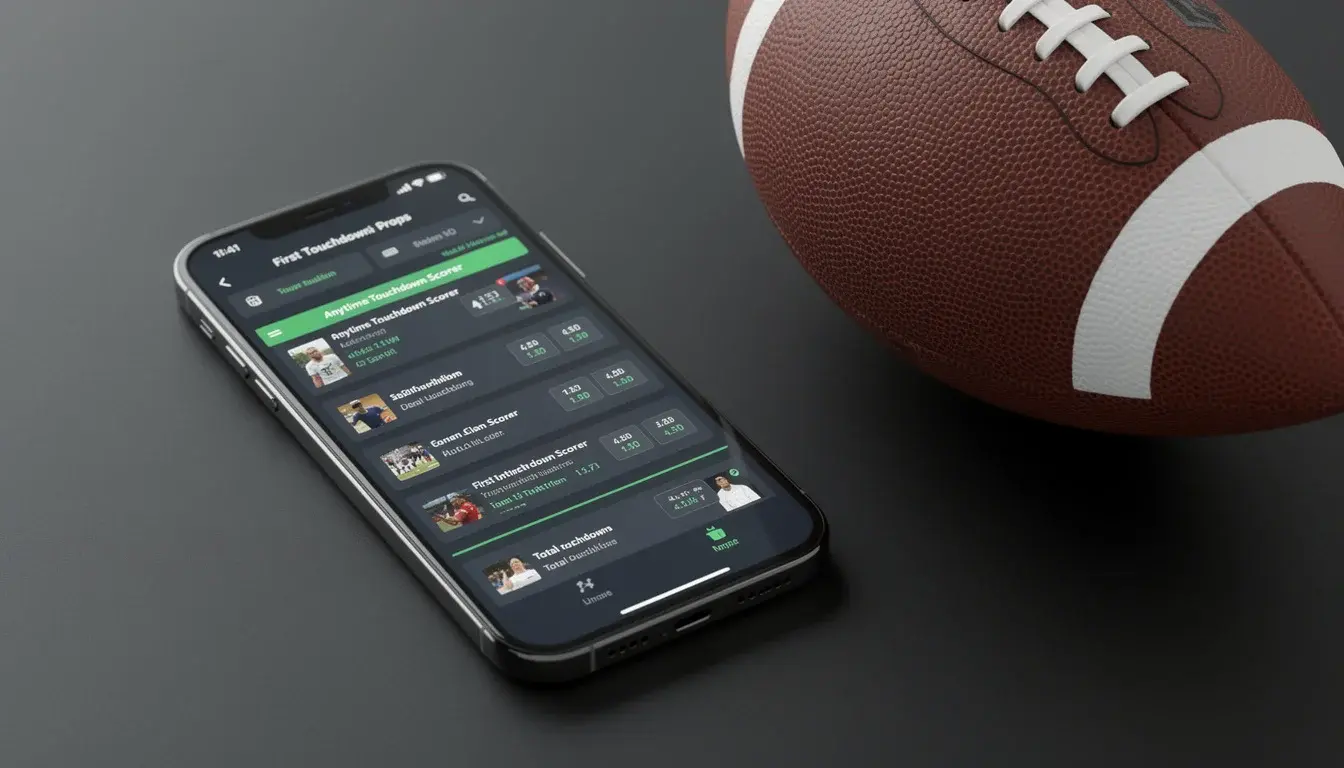


I once hit a first touchdown scorer bet at 14/1 on a tight end who caught a fade route on the opening drive. The payout was fantastic. What happened next was less fantastic – I spent the following six Sundays chasing that high, backing long-shot first TD picks without any process behind them, and gave back every penny of profit plus some. First TD betting is the most volatile corner of the NFL prop market, and that volatility is both its appeal and its danger.
This guide is not a weekly picks column. It is a strategic framework for approaching the first touchdown scorer market in a way that manages variance while identifying genuine value. The odds are long, the hit rate is low, and the variance is brutal – but the market is also inefficient enough that a disciplined approach can produce positive expected value over time. The key word is “disciplined.”
First TD Scorer Markets: Evaluating Long-Shot Probability Models
A friend asked me last season why he should not just treat first TD bets the same as anytime TD bets but with better odds. The answer took me about ten minutes to explain, but it boils down to one word: sample. An anytime touchdown scorer has the entire game – 60 minutes of regulation, potentially overtime – to find the end zone. A first touchdown scorer has exactly one opportunity: the first scoring drive of the game. That is it. Once someone else scores, every other player’s first TD bet is dead.
This structural difference changes the analytical approach entirely. For ATTS picks, I focus on red zone volume, snap counts, and full-game usage. For first TD picks, I focus on opening drive tendencies, first-possession scripts, and which team is likely to receive the opening kick-off. The data inputs are different, the time horizon is different, and the variance is on a completely different scale.
BetIQ’s analysts make the point well: first TD prop bets require finding the right balance of opportunity, matchup potential, and price. Given the variance and long-shot odds, managing expectations is key – extended cold streaks are a real possibility. I cannot stress this enough. A bettor who hits 20% of first TD picks at average odds of 8.00 is performing extremely well, but that means losing 80% of bets. Eight out of ten Sundays, your first TD pick will not hit. You need to be psychologically and financially prepared for that reality before entering this market.
The payoff for enduring that variance is genuine market inefficiency. Bookmakers price first TD markets with wider margins than ATTS markets because the outcomes are harder to model, which means the odds are often looser than they should be. A systematic approach that identifies even small edges can produce positive returns over a full season precisely because the odds are long enough to compensate for the low hit rate.
Opening Drive Scripts and First 15 Plays
Every NFL offensive coordinator scripts the first 15 to 25 plays of a game in advance. These are not suggestions – they are a fixed sequence, rehearsed during the week, designed to exploit specific weaknesses in the opposing defence. Understanding what those scripts tend to look like for each team is the single biggest analytical advantage you can have in the first TD market.
Opening scripts exist because the first possession of the game is the only time an offence operates without needing to react to what has happened so far. There is no score to chase, no clock to manage, no game-script adjustment required. The play-caller runs exactly what he planned, and the players he features in those opening plays are disproportionately likely to touch the ball on the game’s first scoring opportunity.
I track two things about opening scripts. First, which players are featured in the first five plays of the game – specifically, who gets carries and targets on the initial drive. A running back who receives the handoff on three of the first five plays is clearly the centrepiece of that team’s opening plan, and if the drive reaches the red zone, he is the most likely scorer. Second, I track how often each team’s opening drive reaches the end zone versus stalling for a field goal or a punt. Some teams are elite on opening possessions – they convert their scripted plays into touchdowns at a rate well above their overall red zone average. Those teams are where I focus my first TD analysis.
The NFL averaged 18.7 million viewers per game during the 2025 season, the second-highest figure in history. With that many eyeballs, the broadcast networks love first-drive touchdowns, and the data to analyse them is more accessible than ever. If you want to dive deeper into how scripted plays create early scoring opportunities and where to find the specific data, the opening scripts analysis guide covers the full methodology.
One practical note: opening script tendencies are most stable from Week 4 onwards. The first three weeks of the season feature too much experimentation and game-planning novelty for the patterns to be reliable. I typically sit out the first TD market entirely in Weeks 1 through 3 and only start placing bets once the data has had time to stabilise.
Historical First TD Scorer Patterns by Position
I spent an entire off-season going through three years of NFL scoring data, tallying every first touchdown of every game by the position of the scorer. The results were not what I expected. Running backs score the first touchdown of the game more often than any other position – but only just. Wide receivers are close behind, and tight ends are significantly underrepresented despite their red zone involvement in many offences. The distribution shifts meaningfully depending on the era and the league’s stylistic trends, but the broad pattern holds.
Running backs benefit from opening drive scripts that lean heavily on the ground game. Coaches want to establish the run early, and when an opening drive reaches the end zone, it is frequently a running back who punches it in from short yardage. The 23.1% of all touchdowns scored from the 1- or 2-yard line are disproportionately rushing touchdowns, and opening drives are where goal-line carries are most predictable because the play-calling follows the pre-planned script rather than reacting to game flow.
Wide receivers score first touchdowns in a different way. Their first TDs tend to come on longer scoring plays – a 15-yard slant where the receiver breaks a tackle, a corner route in the end zone, or a designed screen that goes the distance. These plays are less predictable at the individual level because multiple receivers might be in the progression, and the quarterback’s read determines who gets the ball. This makes backing a specific receiver for first TD riskier than backing a featured running back, but the odds are typically longer, which compensates for the lower probability.
Tight ends are the market’s blind spot. They score first touchdowns at a rate well below their overall touchdown rate, partly because tight ends tend to be used more heavily in the red zone as games progress and defences tire. On opening drives, tight ends are more likely to be used as blockers or safety-valve targets than as primary end zone threats. The exception is the elite pass-catching tight end who runs seam routes and red zone fades – these players score first TDs at a rate closer to wide receivers and are often mispriced because the market lumps all tight ends together.
Quarterbacks are the wildcard. Scrambling quarterbacks score first touchdowns on designed runs and read-option keepers, and their odds are almost always long because the market underestimates how frequently certain QBs are scripted into goal-line runs. I keep a shortlist of mobile quarterbacks with first-drive rushing data, and they produce some of the highest-value first TD bets in the entire market – when the conditions are right.
Matchup Factors That Matter for First Scores
73.9% of NFL touchdowns are scored inside the red zone, but here is the thing about first touchdowns specifically – they do not always come from the red zone. A disproportionate number of first TDs come on longer plays: a 40-yard catch-and-run, a breakaway rushing touchdown, a pick-six. This means the defensive matchup analysis for first TD picks is different from the analysis I use for ATTS picks, where red zone defence is the dominant factor.
For first TDs, I evaluate three matchup dimensions. The first is opening drive defensive efficiency – how well a defence performs on the opponent’s first possession. Some defences are notoriously slow starters, allowing touchdowns on opening drives at a rate significantly above their overall scoring rate. Others are disciplined from the first snap. I track this metric weekly, and the gap between the best and worst opening-drive defences is wide enough to shift the probability of a first TD by several percentage points.
The second dimension is the coin toss and kick-off decision. The team that receives the opening kick-off has the first opportunity to score, which doubles the first TD probability for their offensive players compared to the team that kicks off. Most NFL teams that win the coin toss defer to the second half, meaning the team that loses the toss typically receives first. I check each team’s coin toss tendencies before placing a first TD bet – it sounds trivial, but it immediately halves the candidate pool.
The third dimension is pace. Fast-paced offences that run more plays per drive create more individual scoring opportunities per possession than slow, methodical offences. A team averaging eight plays per opening drive gives its players eight chances to be the one who crosses the goal line. A team averaging five plays per drive gives its players five. At a fundamental level, first TD scoring is a function of volume on a single possession, and pace directly determines that volume.
The Denver Broncos allowed opponents to convert in the red zone at just 42.6% during the 2025 season. That rate suppresses first TD probability for any offensive player facing them, but it especially suppresses running backs, who rely on short-yardage opportunities that a defence this good is likely to deny. Against elite red zone defences, I shift my first TD focus towards receivers who can score from outside the red zone on big plays, where the defensive front has less impact.
Reading First TD Scorer Odds and Finding Value
The first time I seriously analysed first TD odds across a full slate, I noticed something that changed my approach permanently. The favourite – the player with the shortest odds – scored first in fewer than 10% of games. That means the market’s top pick was wrong more than nine times out of ten. If the favourite is wrong that often, the pricing across the entire market is loose, and loose pricing means value exists for anyone willing to dig.
First TD odds in the UK market typically range from 6.00 to 30.00 in decimal, with most featured players priced between 8.00 and 15.00. The implied probability at 10.00 is 10%, which means the bookmaker believes that player has roughly a one-in-ten chance of scoring first. Your job is to determine whether the true probability is higher or lower than what the price implies, and to bet only when you believe the true probability exceeds the implied probability by a meaningful margin.
I calculate my own rough probability for a first TD pick using four inputs: the player’s share of his team’s expected first-drive touches (from opening script data), the team’s opening drive touchdown rate, the probability that the team receives the opening kick-off, and the defensive matchup rating. I multiply these factors together to get an estimated probability, then compare it to the bookmaker’s implied probability. If my estimate exceeds the bookmaker’s by at least 15%, I have a bet. Below that threshold, the edge is too thin to justify the variance.
Russell Street Report’s analysts describe closing line value as evidence that your analysis contains insight the broader market eventually priced in. This principle applies to first TD bets with even more force than to ATTS picks. If you consistently take first TD prices that shorten before kick-off, you are demonstrating that your opening-script analysis and matchup evaluation are capturing information the market is slow to incorporate. Tracking CLV on first TD bets is harder because the market is less liquid and prices move less predictably, but it is still the most reliable measure of whether your approach has genuine edge.
One warning about odds shopping: first TD markets are one of the areas where prices vary most between UK bookmakers. I have seen the same player priced at 9.00 at one operator and 12.00 at another for the same game. That is a 33% difference in implied probability, and it is free value for anyone maintaining accounts with multiple bookmakers. Line shopping is always important, but in the first TD market, it is close to essential.
Managing Variance on Long-Shot First TD Bets
I went seven straight weeks without hitting a first TD bet during the 2024 season. Seven Sundays of picking a player, watching someone else score first, and writing “L” in my tracking spreadsheet. My bankroll for first TD props dropped by 35%. Then I hit three winners in four weeks at an average price of 11.00, and I was back in profit for the season. That is the reality of this market – the swings are violent and the losing streaks are long.
The maths of variance in long-shot markets is unforgiving but important to understand. If your true win rate on first TD picks is 15% (which would be excellent), the probability of a seven-game losing streak in any given stretch of 17 games is approximately 30%. That is not bad luck – it is expected. If you are not prepared for those streaks, the first one will either drain your bankroll or break your discipline, and either outcome ends your participation in the market.
My staking approach for first TD bets is deliberately conservative. I allocate no more than 0.5% of my total prop bankroll per first TD pick, which is half what I stake on ATTS bets. The lower stake reflects the higher variance, not lower confidence in the analysis. Over a full season of 60 to 70 first TD picks, the total exposure remains manageable, and a single winner at 10.00 or higher returns enough to absorb multiple losses.
I also set a firm season budget for first TD props that I will not exceed regardless of results. Once the budget is gone, I stop. This prevents the destructive pattern I fell into during my early years – chasing losses by increasing stakes, which amplifies the variance I was already struggling to handle. The budget acts as a circuit breaker, and every experienced bettor I know who works this market has something similar in place.
Tracking results weekly is important, but evaluating the process monthly or quarterly is far more valuable. A single week tells you nothing about first TD edge. A single month tells you very little. A full season of 60+ bets starts to provide meaningful data on whether your approach is producing positive expected value. The UK sports betting market is projected to reach $21.3 billion by 2030 at 11.4% annual growth – the opportunity is not going away, and there is no reason to rush the evaluation of your process.