

NFL Touchdown Prop Betting: Advanced Analytics Framework
I placed my first anytime touchdown scorer bet in 2014 from a flat in Manchester, squinting at a laptop stream of a Thursday night game I had no business watching at 1:30 in the morning. The bet lost. The second one lost too. But somewhere around the fifth or sixth attempt, something clicked — not luck, but a method. Twelve years later, I have spent more hours than I care to admit pulling apart red zone data, tracking line movements, and building frameworks that separate the sharp touchdown picks from the noise. This guide is the result of all of it.
Touchdown scorer bets have become the single most popular player prop market in American football. The NFL itself has grown into a phenomenon on this side of the Atlantic, with 13 million fans across the United Kingdom, 4 million of whom describe themselves as avid followers of the sport. That audience is not just watching — it is betting. And the touchdown scorer market sits right at the intersection of what makes NFL wagering so compelling: it rewards knowledge of the game, rewards attention to data, and offers genuine opportunities for punters who put in the work.
This guide covers the full landscape of NFL touchdown betting from a UK perspective. I will walk you through the mechanics, the rules that trip people up, the red zone analytics that actually predict scoring, and a strategic framework I have refined over more than a decade. Whether you are placing your first touchdown bet or sharpening an approach that has gone flat, everything here is built on real data and hard-earned experience — not recycled tips from an American site that has never heard of an accumulator.
The Numbers and Strategies That Shape Every TD Bet
- 73.9% of all NFL touchdowns are scored from the red zone, making red zone volume the single most important predictor for touchdown scorer picks.
- Running backs dominate goal-line scoring (86.6% of rushing TDs come from the red zone), but wide receivers are claiming a growing share of the market as offences pass more.
- Parlay bets carry an average bookmaker hold rate above 15% — singles with disciplined staking give your edge better odds of expressing itself over time.
- The UK has 13 million NFL fans, a growing ecosystem of bookmakers offering TD props, and regulatory changes in 2026 that every punter should understand.
- Value comes from comparing your estimated scoring probability against the bookmaker's implied probability — not from picking the most obvious scorer.
What Are NFL Touchdown Bets?
Years ago, a mate who had never watched American football asked me why I spent so much time on "that one market." I told him it was because touchdown bets strip away the complexity of NFL wagering and give you a single, clean question: will this player reach the end zone? He understood that instantly. That simplicity is exactly why the market has exploded.
A touchdown bet is a type of player proposition wager — a prop bet — where you back a specific player to score a touchdown during a game. You are not predicting the final score, the point spread, or who wins. You are making a focused call on an individual. Football in the United States accounts for roughly 34% of the entire sports betting handle across licensed American bookmakers, and within that enormous volume, touchdown scorer props consistently rank as the most-wagered player prop category.
Player prop bet — a wager on an individual player's performance in a specific statistical category, rather than on the outcome of the game itself.
The appeal for UK punters is straightforward. You do not need to understand every nuance of the American football playbook to have a view on whether a dominant running back will find the end zone against a porous defence. The market rewards the kind of targeted research that British bettors already do with football goalscorer markets. If you have ever backed a Premier League striker to score anytime, the mental model translates directly — the data inputs are just different.
Touchdown bets are settled on official NFL scoring. The player must physically carry or catch the ball into the end zone. A quarterback who throws a touchdown pass to a receiver has not scored a touchdown himself — only the receiver has. This distinction catches out more beginners than any other rule in the market.
The market operates across several sub-types, each with its own risk-reward profile. The most common is the anytime touchdown scorer bet, but first scorer, last scorer, and multiple touchdown markets all carry different strategic implications. Understanding the differences is not optional — it is the foundation everything else builds on.

Anytime, First, Last, and Multiple TD Scorer Markets
Each touchdown scorer market answers a slightly different question, and the odds reflect that difference sharply. Here is how they break down.
The anytime touchdown scorer (often abbreviated ATTS) is the bread-and-butter market. You are backing a player to score at least one touchdown at any point during the game — first quarter, fourth quarter, overtime, it does not matter. Because the window of opportunity spans the full game, odds are shorter than the other variants. A strong running back with heavy goal-line usage might be priced around 1.50 to 2.00 in decimal odds. This is the market where volume lives and where most of the strategic frameworks in this guide apply.
The first touchdown scorer market is a different animal entirely. You need your player to score the very first touchdown of the game — not just any touchdown. Because only one player can win, the odds are considerably longer. Even a heavy favourite might sit at 7.00 or 8.00 decimal. The variance is brutal, the cold streaks are real, and the analytical approach changes significantly. I cover the full strategy for this market in my guide to first touchdown scorer picks.
| Market | What You Need | Typical Odds Range | Variance Level |
|---|---|---|---|
| Anytime TD Scorer | Player scores 1+ TD in the game | 1.40 – 4.00 | Moderate |
| First TD Scorer | Player scores the game's first TD | 6.00 – 20.00+ | Very high |
| Last TD Scorer | Player scores the game's final TD | 6.00 – 20.00+ | Very high |
| Multiple TD Scorer (2+) | Player scores 2 or more TDs | 3.50 – 10.00+ | High |
The last touchdown scorer market mirrors the first scorer in structure but introduces game script as a dominant variable. Late-game touchdowns often come from backup running backs grinding out clock or from desperation passing plays by trailing teams. The randomness is higher, and the analytical edges are thinner.
Example: Reading ATTS odds across formats
Suppose a running back is priced at 1.80 decimal odds to score anytime. In fractional odds — the format most UK bookmakers default to — that is 4/5. In American odds, it is -125. All three express the same implied probability: roughly 55.6%. A GBP 10 stake returns GBP 18 total (GBP 8 profit) if the player scores.
The multiple touchdown scorer market asks whether a player will score two or more touchdowns. The odds jump sharply because even elite scorers rarely hit two in the same game. This is a market I approach with extreme selectivity — high-volume red zone players in games with elevated totals are the only profiles worth considering.
One critical point that separates these markets: your strategic inputs change with each one. ATTS rewards identifying consistent red zone involvement. First scorer rewards understanding opening drive scripts and receiving the first possession. Last scorer rewards reading game script and clock management tendencies. Treating them as the same market with different odds is a mistake I see constantly.
Scoring Rules Every UK Punter Must Know
I once watched a punter on a betting forum celebrate a "guaranteed winner" because his quarterback had thrown three touchdown passes. His anytime TD scorer bet on that quarterback lost. He did not understand the rules. That single misunderstanding probably costs UK bettors more money collectively than any bad pick ever has.
Touchdown scorer bets are settled on a specific definition of scoring: the player must be in physical possession of the ball when it crosses the goal line or when the player is in the end zone. Throwing a touchdown pass does not count as scoring a touchdown — the thrower is credited with a passing touchdown in the box score, but for betting purposes, only the player who caught or carried the ball has scored.
The golden rule: if a player's hands are on the ball when it enters the end zone, the touchdown counts. If the player released the ball before it reached the scorer, it does not. This applies to quarterbacks, running backs, wide receivers, tight ends — everyone.
This rule has practical consequences beyond the obvious quarterback exclusion. A lateral play where the ball changes hands near the goal line? Only the final ball carrier gets the touchdown. A fumble recovery in the end zone by a defensive player? That counts for the defender, not for the offensive player who lost the ball. The analysts at BetIQ put it well when describing first TD props: finding the right balance of opportunity, matchup potential, and price is the core challenge, but managing expectations around the rules is where it starts.
Do
- Check whether your bookmaker counts defensive and special teams touchdowns for scorer bets — most do, but rules vary
- Verify the overtime policy before placing your bet, especially for first TD scorer markets
- Read the specific settlement rules for voided and inactive players at your chosen bookmaker
- Understand that a rushing quarterback touchdown counts, but a passing one does not
Don't
- Assume a quarterback's passing touchdowns will settle your bet as a winner
- Ignore the difference between the broadcast call and the official NFL scoring — bets settle on the latter
- Treat all UK bookmakers' rules as identical; they diverge on edge cases more than you would expect
- Forget to check whether a player is active before kickoff — inactive players typically void the bet leg
These rules are not footnotes. They are the structural foundation of the market. Every strategy, every pick, every parlay I discuss in this guide assumes you have internalised them. If you want the full breakdown of how different UK bookmakers handle settlement, edge cases, and rule divergences, I have written a dedicated piece that covers it in detail.
The Passing Touchdown Exception
This single rule generates more confusion than anything else in the market, so it deserves its own space.
When a quarterback drops back and throws a 40-yard touchdown pass, the NFL's official statistics credit the quarterback with a passing touchdown and the receiver with a receiving touchdown. For touchdown scorer bet purposes, only the receiver has scored. The quarterback has not. He facilitated the score — he did not make it himself.
The exception within the exception: if the quarterback runs the ball into the end zone, that is a rushing touchdown, and it absolutely counts. Dual-threat quarterbacks who regularly scramble for goal-line scores can be genuine ATTS candidates. The key metric to check is rushing attempts inside the 5-yard line. A quarterback with three or four of those per game is a different proposition entirely from a pocket passer who never crosses the line of scrimmage.
Some UK bookmakers offer a separate "quarterback touchdown" market where passing touchdowns do count. This is a distinct market from the standard anytime touchdown scorer. If you see unusually short odds on a quarterback in what appears to be an ATTS market, double-check the market name — you may be looking at a QB-specific prop with different rules.
The practical takeaway: when scanning ATTS markets, skip quarterbacks entirely unless they have a demonstrated history of rushing for touchdowns. Even then, treat them as speculative picks with a narrow path to cashing. The real value in touchdown scorer markets lives with running backs, wide receivers, and tight ends — the players who physically carry or catch the ball into the end zone with regularity.
Overtime, Replay Reviews, and Bookmaker Differences
Two questions come up every single week from punters new to this market: does overtime count, and what happens if a touchdown gets overturned?
Overtime touchdowns count for anytime touchdown scorer bets at the vast majority of UK bookmakers. The game is not over until it is over, and the standard settlement covers full regulation plus any overtime period. Where it gets complicated is the first touchdown scorer market. Some bookmakers settle first TD as the first score of the game regardless of period, meaning an overtime score could technically be the "first" touchdown if the game was scoreless through regulation. Others restrict first scorer to regulation only. This is not a theoretical edge case — it has happened, and the punters who did not read the rules were the ones who lost.
Always check your bookmaker's specific overtime policy for the exact market you are betting. The general statement "overtime counts" is true for ATTS at most operators, but first scorer and last scorer markets can have different settlement rules. A two-minute read of the terms saves hours of frustration.
Replay reviews add another layer. The NFL uses a challenge and review system where referees can overturn a touchdown call after watching video replays. For betting purposes, what matters is the official final scoring as recorded in the NFL's game book — not the on-field call as it happened in real time. If a touchdown is initially called, then overturned on review, it never happened for settlement purposes. The reverse is also true: a play initially ruled short of the goal line that is later awarded a touchdown on review does count.
The gap between UK bookmakers on these edge cases is wider than most punters realise. I have seen divergences on how voided legs are handled in accumulators, on whether a player who is active but does not take the field counts as "having played," and on the treatment of defensive touchdowns in scorer markets. When these edge cases hit your bet slip, the differences matter.
Red Zone Analytics: Where Touchdowns Are Made
If there is one number that changed how I approach touchdown betting, it is this: 73.9% of all NFL touchdowns historically come from inside the red zone — the area within 20 yards of the opponent's goal line. In the 2024 season, that figure climbed to 77.2%. The red zone is not just where touchdowns happen frequently; it is where they happen overwhelmingly.
That single data point reshapes how you evaluate touchdown scorer candidates. A wide receiver who catches eight passes a game for 120 yards but rarely gets targeted inside the 20 is a fantasy football darling but a mediocre ATTS selection. A running back who averages 3.2 yards per carry but gets four or five touches inside the red zone every week is a machine for this market. The volume of opportunity near the goal line matters more than almost any other factor.
Nearly a quarter of all NFL touchdowns — 23.1% — are scored from the 1- or 2-yard line. The closer to the goal line, the more the game compresses into pure power football, and the more predictable the scorer becomes.
The numbers become even more dramatic when you break them down by type of score. Rushing touchdowns are the most red-zone-dependent category: 86.6% of all rushing touchdowns originate from inside the 20. Running backs and goal-line specialists dominate this zone because short-yardage situations favour power running and designed QB sneaks. Passing touchdowns have a wider distribution — some come from explosive plays well outside the red zone — but the majority still originate from within 20 yards.
Red zone efficiency is the rate at which a team converts red zone trips into touchdowns rather than settling for field goals. The Philadelphia Eagles led the NFL in 2025 with a 70.97% red zone touchdown conversion rate. When a team converts at that level, their skill players get more touchdown opportunities per game, which directly improves ATTS hit rates. As a practical rule, red zone efficiency predicts individual scoring better than total yardage, total points, or most other team-level metrics. Elite red zone offences — those converting above 65% with four or more red zone trips per game — generate the kind of consistent scoring volume that makes ATTS picks reliable rather than speculative.
Applying red zone data to a real scenario
Suppose Team A averages 4.2 red zone trips per game and converts 68% into touchdowns. That is roughly 2.86 touchdowns per game from the red zone alone. Their lead running back handles 45% of red zone carries. That gives him roughly 1.3 expected red zone carries per game — and with a goal-line touchdown rate of around 40% on those carries, his implied ATTS probability from red zone work alone is approximately 52%. If the bookmaker prices him at 1.75 (implied 57.1%), the margin is tight. If they price him at 2.00 (implied 50%), the value is clearer.
I go much deeper into red zone efficiency rates, the red zone plus/minus metric, and how to apply goal-line data to weekly picks in my dedicated NFL red zone betting strategy guide. For the purposes of this overview, the takeaway is simple: if you are not checking red zone data before placing a touchdown bet, you are guessing.
Red zone data tells you where touchdowns happen. The next question is who scores them — and that depends on position.
Positional Scoring Trends: RBs, WRs, and TEs
Not all positions score touchdowns at the same rate, and the distribution has shifted meaningfully over the past decade as the NFL has become increasingly pass-heavy.
Running Backs
The most consistent ATTS candidates. Running backs dominate short-yardage and goal-line situations, where 86.6% of rushing touchdowns originate from inside the red zone. Their scoring is high-volume but lower-odds, typically priced between 1.40 and 2.50 for elite backs.
Wide Receivers
Growing share of the touchdown market. In Super Bowl 59, five of seven total touchdowns were caught by wide receivers — a snapshot of how pass-heavy modern offences have become. WRs typically carry longer ATTS odds (2.00 to 4.00+) but can offer value when they hold dominant red zone target shares.
Tight Ends
The overlooked position. Elite tight ends with high red zone target shares score consistently but are often priced longer than their touchdown frequency justifies. They are a smaller pool, which makes identifying the right ones easier.
The trend line is clear: wide receivers have been eating into the running back's historical dominance of the touchdown market. Passing touchdowns now make up a larger share of NFL scoring than at any previous point, and the receivers catching those passes are the ones being credited with the scores. That said, running backs remain the backbone of the ATTS market because their path to the end zone is shorter and more repeatable — a goal-line carry from the 1-yard line is about as predictable as football gets.
For ATTS betting specifically, I favour a mix: running backs as the core of the portfolio for consistency, wide receivers for value when the matchup and target share data align, and tight ends as occasional plays when the price is right. The worst approach is to fixate on one position and ignore the others. Each week, the data tells you which position group has the best opportunities — and that shifts based on matchups, injuries, and game script projections.
A Data-Driven Strategy Framework for TD Props
Here is something I wish someone had told me in my first year of betting touchdowns: the punters who win consistently are not the ones who pick the most scorers correctly. They are the ones who find prices that are wrong. That distinction — between picking winners and finding value — is the entire game.
The framework I use starts with a question that has nothing to do with individual players. Before I look at a single name, I look at the game environment. What is the projected game total? What are the red zone efficiency rankings of both teams? Is the defence allowing high touchdown conversion rates, or is it forcing field goals? The Philadelphia Eagles converted 70.97% of their red zone trips into touchdowns in 2025 — the best rate in the NFL. A team operating at that level creates a scoring-rich environment for its skill players. Identifying which end of the efficiency spectrum your target player is operating in is the first filter, and it eliminates a surprising number of bad bets before you have even opened an odds comparison.
Pre-bet checklist: five questions before every TD wager
- What is the game total? Higher projected totals mean more scoring opportunities across the board.
- What is the offensive team's red zone TD conversion rate? Above 60% is strong; above 65% is elite.
- What is the defensive team's red zone TD rate allowed? Above 60% suggests vulnerability.
- How many red zone touches or targets does the player receive per game? Minimum threshold: 2+ per game for RBs, 1.5+ for WRs.
- Is the player healthy and confirmed active? Check the final injury report — not the Wednesday estimate.
Once the game environment passes the filter, I move to the player level. Red zone volume is the anchor metric: how often does this player touch or get targeted in the red zone per game? A running back with 3.5 red zone carries per game in a team that generates 4+ red zone trips is in a structurally different position from a back with 1.2 carries on a team that visits the red zone twice a game. The first player's scoring is almost a mathematical expectation; the second is a hope.
The final layer is price. I estimate the player's true scoring probability from the data — red zone volume, touchdown rate in scoring situations, historical conversion — and compare it to the implied probability embedded in the bookmaker's odds. If my estimated probability exceeds the implied probability by a meaningful margin, the bet has expected value. If it does not, I pass, regardless of how confident I feel about the pick. Feeling confident and having value are not the same thing, and the market does not care about your gut.
Consistently beating the closing line — the final odds before kickoff, after the market has absorbed all available information — is the strongest signal that your analysis contains genuine edge. The closing line represents the market's most informed view, and if your bets consistently sit at better prices than where the line closes, you are identifying value that the broader market later recognises. I track this metric for every bet I place, and I cover the full methodology in my anytime touchdown scorer strategy guide.
A framework is only as good as its inputs. One of the most important inputs — and the one most punters underuse — is defensive matchup data.

Defensive Matchup Analysis and Game Script
The offensive player gets the glory, but the defensive matchup dictates the opportunity. I have lost count of the times a talented running back was held scoreless because I failed to account for the defence he was running against.
The metric I lean on most heavily is defensive red zone touchdown percentage allowed — the rate at which a defence allows opponents to convert red zone trips into touchdowns rather than field goals. The Denver Broncos were the outlier of the 2025 season, holding opponents to just a 42.6% red zone TD conversion rate. That is a suppressive environment. A running back facing the Broncos needed to be priced at significantly longer odds to justify the bet, regardless of his own offensive metrics. On the other side, defences allowing 65%+ red zone conversions are gift-wrapping touchdown opportunities for opposing skill players.
Matchup-driven adjustment in practice
A running back averages 2.8 red zone carries per game and scores on roughly 35% of those opportunities — an implied ATTS probability of around 63%. Against a top-5 red zone defence, his conversion rate drops to maybe 25%, pulling the probability down to roughly 52%. Against a bottom-5 red zone defence, conversion rises to 45%, pushing probability above 72%. Same player, same week, three entirely different betting conclusions depending on the opponent.
Game script matters because it determines how many opportunities a player gets. A team expected to lead by a comfortable margin will likely run the ball more in the second half to drain the clock, increasing rushing touchdown opportunities for their backs. A team projected to trail will throw more, which shifts touchdown equity toward wide receivers. The Los Angeles Rams led the NFL in Red Zone Plus/Minus with a score of +141 in the 2025 regular season — a metric that captures how much better a team's red zone efficiency is than its opponents'. Teams with strong positive red zone plus/minus are not just scoring; they are generating disproportionate touchdown volume relative to their opposition, and their skill players benefit accordingly.
The practical application is to combine these defensive metrics with your player-level analysis. A high-volume red zone back facing a poor red zone defence in a game where his team is favoured — that is the three-factor alignment that produces consistent ATTS winners. Missing even one factor — the volume, the matchup, or the game script — weakens the case substantially.
Singles vs Parlays: Expected Value for TD Bets
Every week someone asks me whether they should parlay their touchdown picks or bet them as singles. The honest answer is that it depends on what you are trying to do — but the maths overwhelmingly favours singles for anyone serious about long-term profit.
Parlays — or accumulators, as they are known across UK betting shops — combine multiple selections into a single bet where all legs must win for a payout. The appeal is obvious: the odds multiply, and a four-leg accumulator of ATTS picks at 2.00 each pays 16.00 instead of four separate payouts of 2.00. The problem is equally obvious: the probability of all four hitting is 6.25% in a fair market, and the bookmaker's margin makes it worse. Parlay bets accounted for 22% of the total handle across US bookmakers in 2024, with an average hold rate above 15% — meaning bookmakers kept over 15 pence of every pound wagered on parlays. That hold rate on singles is dramatically lower.
| Factor | Singles | Parlays / Accumulators |
|---|---|---|
| Expected return per GBP wagered | Higher (lower bookmaker margin) | Lower (compounding margins) |
| Variance | Lower — results stabilise faster | Higher — longer losing streaks |
| Bankroll requirement | Larger per-bet outlay for same total action | Smaller per-bet, but higher risk of ruin |
| Best suited for | Consistent value seekers | Entertainment, occasional shots |
Expected value comparison: singles vs a three-leg parlay
Three ATTS picks, each at 2.00 decimal odds. Assume each has a true probability of 55% (positive EV individually).
Singles: expected value per bet = (0.55 x 2.00) - 1 = +0.10 per unit. Three bets = +0.30 expected profit on 3 units wagered.
Three-leg parlay: combined odds = 8.00. True combined probability = 0.55^3 = 16.6%. EV = (0.166 x 8.00) - 1 = +0.33 on 1 unit wagered.
The parlay looks more capital-efficient, but one loss in any leg wipes out the entire bet. Over 100 repetitions, the singles bettor has a smoother, more predictable return curve. The parlay bettor has wilder swings and a higher probability of drawdown.
That said, I am not dogmatic about this. UK bookmakers offer bet builders and same game parlays that let you combine touchdown picks with other props from the same game. Correlated parlays — where the outcomes are linked (for example, a team's running back to score and the team to win) — have a mathematical structure that differs from independent parlays. The correlation reduces the compounding penalty because the events are not truly independent. I break down exactly when and how to use these tools in my parlay strategy guide for touchdown props.
My baseline recommendation: bet your highest-conviction ATTS picks as singles. Use parlays sparingly, with no more than two or three legs, and only when you have identified genuine correlation between the selections. Treat any accumulator with four or more legs as an entertainment bet, not a strategy bet — size it accordingly and do not let it become a habit that drains your bankroll.
UK Bookmakers for NFL Touchdown Props
Moving to the UK from a US-centric betting perspective felt like switching from a motorway to a roundabout — same destination, completely different navigation. The UK market has its own ecosystem of bookmakers, its own promotional structures, and its own regulatory framework. And the coverage of NFL touchdown props varies more between operators than most punters expect.
Around 10% of the UK population places online sports bets, which translates to millions of active accounts spread across dozens of licensed operators. Not all of those operators offer deep NFL prop markets. Some provide extensive touchdown scorer coverage with 30 or more players priced per game, while others offer a skeleton menu of five or six names. The depth of the market directly affects your ability to find value — if your bookmaker only prices the obvious candidates, the mispriced selections you need are simply not available.
What I look for in a UK bookmaker for NFL touchdown props breaks down into five categories: market depth (how many players are priced), competitive odds (are the prices in line with or better than the broader market), rule transparency (are the settlement rules for overtime, replay reviews, and voided players clearly published), bet builder availability (can I combine TD props with other markets in the same game), and cash-out functionality for in-play flexibility.
All UK-facing bookmakers offering NFL touchdown props must hold a licence from the UK Gambling Commission. This is non-negotiable and should be the first thing you verify before opening an account. UKGC licensing ensures regulatory oversight, dispute resolution processes, and player protection mechanisms that unlicensed operators cannot guarantee.
The UK sports betting market is projected to reach $21.3 billion by 2030, growing at 11.4% annually. Within that growth, NFL betting is a rising segment, driven by expanding UK fandom and the NFL's own investment in London games and Sky Sports broadcasting partnerships. As the market grows, so does the sophistication of NFL prop offerings at UK bookmakers. Operators who offered minimal NFL coverage five years ago are now building dedicated American football sections. For a full comparison of how specific UK bookmakers handle TD prop markets, rules, and features, see my UK bookmaker comparison for NFL touchdown props.

The UK NFL Betting Landscape
The growth of NFL betting in the UK is not happening in a vacuum — it is being driven by a genuine cultural shift. That base of millions of British fans is not passive. Four million identify as avid followers, and the appetite for NFL wagering has followed the viewership growth almost in lockstep.
The UK's total gambling industry generated GBP 16.8 billion in Gross Gambling Yield over the 2024/25 period, a 7.3% increase year on year. Within that, remote casino, betting, and bingo — the online segment that includes NFL props — generated GBP 7.8 billion, growing at 13.1%. Online betting is not just growing; it is the fastest-expanding segment of the entire UK gambling market.
The NFL has made serious institutional commitments to the UK market. Gerrit Meier, the Managing Director and Head of NFL International, has said that the UK remains a priority for driving fandom and growing the game globally. Sky Sports extended its broadcasting partnership with the NFL beyond 30 years, and the league has played 39 regular season games in London since 2007, with the most recent attendance record at Wembley reaching 86,651 for the Jacksonville-New England game in 2025. International NFL games drew a record average of 6.2 million viewers across TV and digital in 2025 — a 32% increase year over year.
For UK punters, this growth has tangible benefits. More demand means more market depth from bookmakers. More London games mean more access to live NFL action at UK-friendly kick-off times. More broadcasting means more familiarity with the players and teams you are betting on. The NFL in the UK is not a fringe product propped up by a handful of enthusiasts — it is a sports-media-betting ecosystem that is reinforcing itself with each passing season.
That said, the UK regulatory landscape is tightening. The remote gaming duty is rising from 21% to 40% from April 2026, and online operators must now conduct financial vulnerability checks when a customer's net spend exceeds GBP 150 within 30 days. The UKGC conducted 9,700 compliance actions in 2024/25, up from 4,200 the year before. These are significant changes that will affect how bookmakers price markets and manage customer relationships. Whether those changes ultimately affect the odds you see on a Thursday night ATTS pick remains to be seen — but being aware of the regulatory direction is part of being an informed punter.
Bankroll Management for Touchdown Props
I blew through my first bankroll in three weeks. Not because my picks were terrible — some of them were fine — but because I had no system for sizing my bets relative to my edge, my bankroll, or my ability to absorb losing streaks. Touchdown prop markets, especially first scorer bets, produce longer cold stretches than most punters are prepared for. Without a staking plan, confidence becomes the enemy: you chase losses after a bad weekend, oversize your next bet, and the spiral accelerates.
The principle is simple. Define your bankroll — the total amount you have set aside for NFL touchdown betting, separate from your living expenses and other obligations. Then define your unit size as a fixed percentage of that bankroll. I use 1-2% per bet as a baseline. On a GBP 500 bankroll, that means individual bets of GBP 5 to GBP 10. On a GBP 2,000 bankroll, GBP 20 to GBP 40. This sounds conservative because it is — and conservatism is the point. Touchdown props carry inherent variance, and the only way to survive the variance is to ensure no single bet or bad week can meaningfully damage your ability to continue.
Do
- Set a fixed bankroll before the NFL season starts and stick to it
- Use flat staking (same unit size per bet) until you have a track record of at least 200 bets
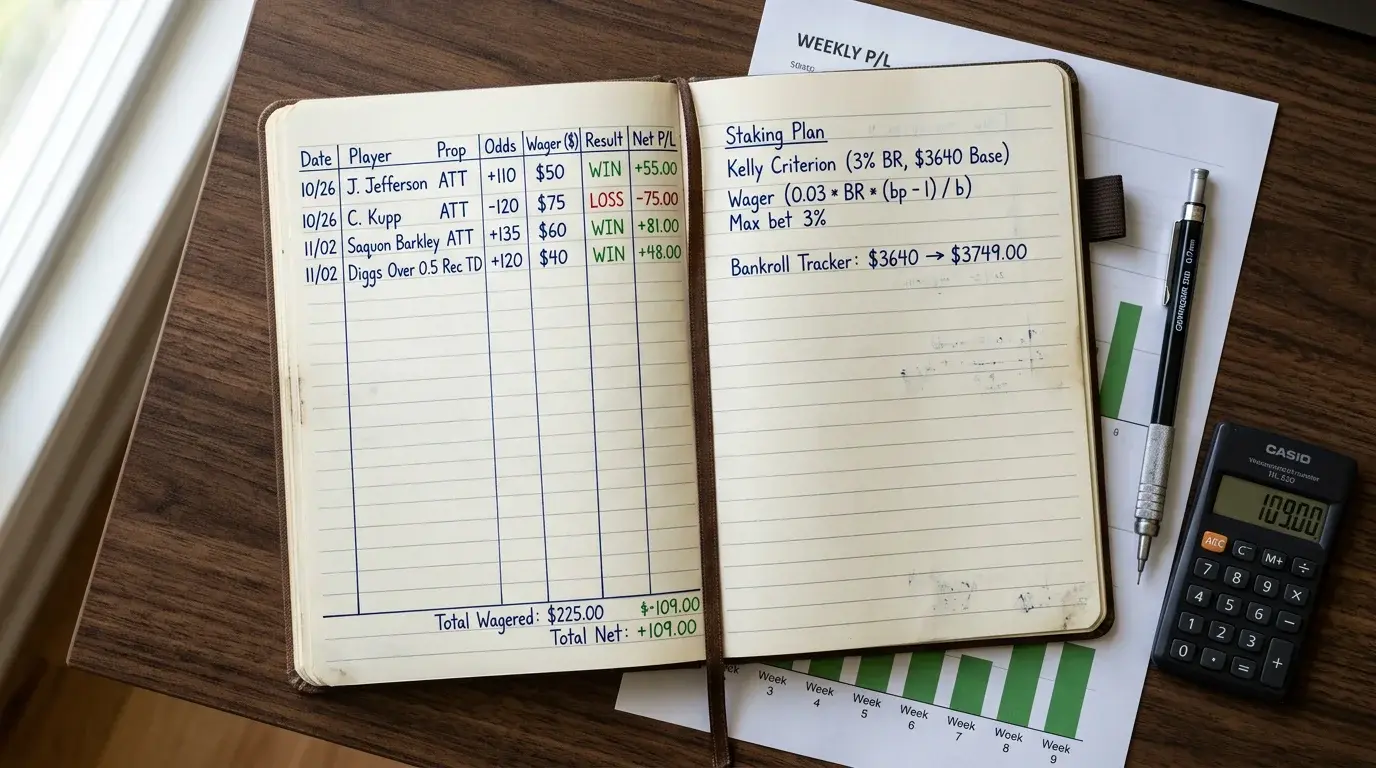
- Track every bet in a spreadsheet: date, player, market, odds, stake, result
- Review your record monthly and adjust unit sizes only based on bankroll changes, not emotions
Don't
- Increase stake sizes after a losing streak to "make it back"
- Bet more than 3% of your bankroll on any single touchdown prop, regardless of confidence
- Fund your betting bankroll with money you cannot afford to lose
- Treat parlays and accumulators as a shortcut to recovering losses
If accumulators are your primary betting vehicle for touchdown props, the compounding margin is working against you at a structural level. The bookmaker's edge grows with each additional leg. Singles with disciplined staking give your analysis room to express itself over hundreds of bets — which is the timeframe that matters.
One more point that often gets overlooked: responsible gambling tools are not a sign of weakness. UK bookmakers are required to offer deposit limits, loss limits, session time limits, and self-exclusion options. I use deposit limits myself — not because I lack discipline, but because having a guardrail removes the temptation to make decisions I would regret. The UK Gambling Commission exists to protect punters, and using the tools they mandate is a rational choice, not a concession. If your betting is ever causing stress, financial strain, or affecting your wellbeing, step back. No touchdown bet is worth compromising your real life for.
Common Questions About NFL Touchdown Bets
What is an anytime touchdown scorer bet and how does it work?
An anytime touchdown scorer bet backs a specific player to score at least one touchdown at any point during the game, including overtime at most UK bookmakers. The player must physically carry or catch the ball into the end zone — passing touchdowns do not count for the thrower. The odds reflect the bookmaker's implied probability of that player scoring, with heavy goal-line backs typically priced shortest.
Do quarterback passing touchdowns count for touchdown scorer bets?
No. When a quarterback throws a touchdown pass, only the player who catches the ball is credited with a score for betting purposes. The only way a quarterback can win a touchdown scorer bet is by rushing the ball into the end zone himself. Dual-threat quarterbacks who regularly scramble near the goal line can be viable ATTS candidates, but traditional pocket passers are not worth backing in scorer markets.
Does overtime count for anytime touchdown scorer bets?
At the vast majority of UK bookmakers, yes — overtime touchdowns count for ATTS bets. The bet covers the full duration of the game including any overtime period. However, first touchdown scorer and last touchdown scorer markets can have different rules. Some bookmakers restrict first scorer to regulation only. Always check the specific settlement terms at your bookmaker before placing the bet.
What happens if a touchdown is overturned by replay review?
Bets are settled on the official final scoring in the NFL game book, not the initial on-field call. If a referee signals a touchdown but the play is overturned on review, it does not count. Conversely, a play initially ruled short that is later awarded a touchdown on review does count. Settlement follows the confirmed official scoring, which may take a short time after the game to finalise.
What is the difference between first, last, and anytime touchdown scorer bets?
Anytime TD scorer requires your player to score at least one touchdown at any point — the broadest market. First scorer requires the game's very first touchdown, with correspondingly longer odds and higher variance. Last scorer requires the final touchdown, which depends heavily on late-game script and substitution patterns. Each demands a different analytical approach: ATTS rewards red zone volume, first scorer rewards opening drive analysis, and last scorer rewards reading clock management and trailing-team tendencies.
Can you parlay multiple anytime touchdown scorer picks together?
Yes. Most UK bookmakers allow you to combine ATTS selections into a parlay (accumulator), and bet builder tools let you combine picks from the same game. However, the bookmaker's margin compounds with each leg — parlays carried an average hold rate above 15% in 2024, compared to significantly lower margins on singles. If you parlay, I recommend limiting it to two or three legs and focusing on selections with genuine statistical correlation.
How are touchdown scorer odds calculated and what do they mean?
Odds reflect the bookmaker's assessment of a player's scoring probability, adjusted by a margin (overround) for profit. A player at 2.00 decimal has an implied probability of 50%; at 3.00, it is 33.3%. UK bookmakers default to fractional odds (4/5, 2/1) but allow switching to decimal or American formats. The core skill is comparing implied probability against your own estimate from red zone data, matchups, and volume. If your estimate exceeds the implied probability, the bet has positive expected value.