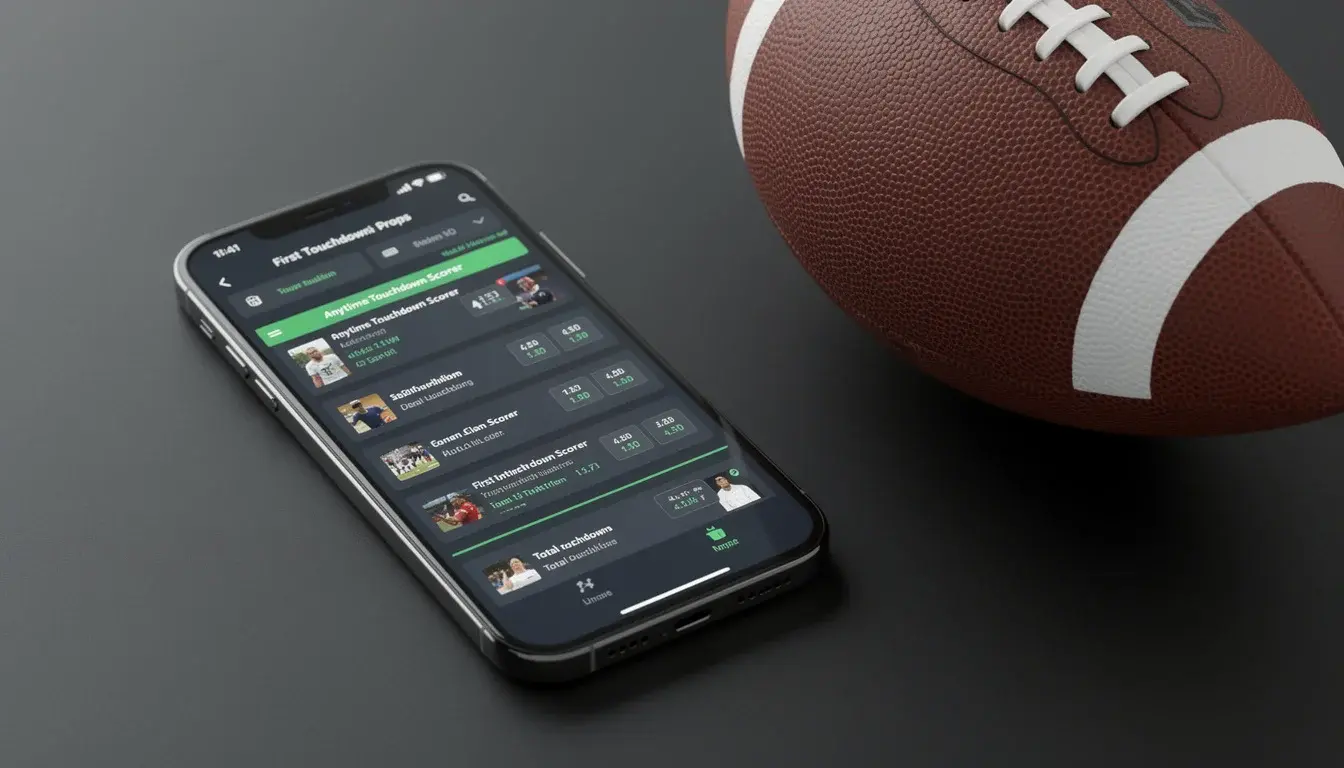

When I placed my first NFL touchdown bet from a UK bookmaker in 2013, the experience was dismal. One operator listed anytime touchdown scorer markets for exactly four games per week, with odds on maybe eight players per game. Fast forward to 2026, and the landscape has transformed. Around 10% of the UK population now bets on sport online, and bookmakers have responded to growing NFL demand by expanding their prop coverage dramatically. The challenge has shifted from finding a bookmaker that offers touchdown props at all to figuring out which one offers the best combination of market depth, competitive odds, and fair settlement rules.
This guide compares the major UK-licensed bookmakers for NFL touchdown scorer markets. I am not ranking them or telling you which one to use – your priorities might differ from mine. Instead, I am laying out the factors that matter, the differences in rules and features that most punters overlook, and the regulatory framework that protects you as a UK bettor. The goal is to help you make an informed choice rather than defaulting to whichever brand has the loudest advert.
When opening a new account, always look to take advantage of NFL touchdown free bets in the UK to boost your initial bankroll.
Bookmaker Verification: Assessing Odds Margins and Market Restrictions
Twelve years of placing NFL prop bets through UK bookmakers have taught me that the flashy features – welcome bonuses, slick apps, celebrity endorsements – matter far less than a handful of fundamentals that directly affect your bottom line. Here is what I check before I put any money into an account for touchdown prop betting.
Market depth and availability. Not all bookmakers list touchdown scorer markets for every game. Some cover the full Sunday slate plus Thursday and Monday night games; others limit their NFL prop offering to marquee matchups. For a serious ATTS bettor working through a systematic weekly process, coverage gaps are disqualifying. If your bookmaker does not list markets for the Jets-Jaguars early kick-off, you cannot act on value that your analysis has identified. I want full-slate coverage with markets published by Wednesday at the latest.
Odds competitiveness. The difference between decimal odds of 2.50 and 2.75 on the same player might seem trivial, but over a season of 80 to 100 ATTS bets, that margin compounds into hundreds of pounds of lost or gained value. I maintain accounts with multiple bookmakers specifically to line-shop – comparing the same player’s odds across three or four platforms and placing the bet where the price is best. If you only use one bookmaker, you are accepting whatever price they set, and that price is rarely the best available.
Settlement rules. This is where most punters get caught out. Does the bookmaker include overtime touchdowns? What happens if a player is inactive on game day? How do they handle a touchdown that is overturned by replay review? These are not hypothetical edge cases – they come up multiple times per season, and the rules vary between operators. I have had the same bet win at one bookmaker and lose at another because of a difference in overtime settlement policy. Understanding these rules before you bet is not optional; it is essential.
Bet builder functionality. The ability to combine touchdown scorer picks with other markets in a same-game parlay or bet builder has become a standard feature, but the implementations differ significantly. Some platforms allow you to combine ATTS picks from different games in a single accumulator; others restrict combinations to within the same match. The payout calculations also vary – some use independent odds multiplication while others apply correlation adjustments that reduce your potential return. I will cover this in more detail in the bet builders section below.
The UKGC conducted 9,700 compliance actions in the 2024/25 period, more than double the 4,200 actions the previous year. That enforcement activity signals an increasingly rigorous regulatory environment, which is ultimately good for bettors. Operators that cut corners on fairness, transparency, or customer protection face real consequences. When evaluating bookmakers, look for those that treat compliance as a baseline rather than a burden.
UK Bookmaker Profiles for NFL Touchdown Markets
Rather than ranking bookmakers from “best” to “worst” – a format that inevitably reflects one person’s preferences rather than objective truth – I am going to describe what each major UK-licensed operator brings to the NFL touchdown prop market. Your ideal bookmaker depends on how you bet, what features you prioritise, and how many accounts you are willing to manage.
The UK sports betting market is projected to reach $21.3 billion by 2030 at a compound annual growth rate of 11.4%, and NFL coverage has been one of the fastest-growing segments. Most major operators now treat American football as a tier-one sport during the season, which means dedicated NFL sections, regular odds boosts, and increasingly granular prop markets including ATTS, first TD, last TD, and 2+ TDs.
The large established operators – the names you see on every Premier League shirt sleeve and every racing broadcast – typically offer the widest market coverage and the most competitive base odds. Their scale allows them to price NFL props with tighter margins because they are managing risk across a massive customer base. The trade-off is that these operators are also the quickest to limit winning accounts, which matters if your process starts producing consistent profits.
Mid-tier operators often compensate for slightly wider odds by offering more aggressive promotional terms – larger odds boosts, more generous free bet offers, and fewer restrictions on accumulator combinations. Their NFL prop coverage tends to be narrower, sometimes missing the less popular games, but their pricing on the games they do cover can be surprisingly competitive. I have found that these operators are also slower to adjust their lines when news breaks, which occasionally creates brief windows of value on Wednesday and Thursday before the market catches up.
Exchange-style platforms operate differently from traditional bookmakers. They allow you to both back and lay outcomes, which means you can effectively set your own odds if another user is willing to match your bet. The advantage for ATTS betting is that exchange odds often exceed traditional bookmaker prices by 5% to 10% because there is no built-in bookmaker margin. The disadvantage is liquidity – NFL player prop markets on exchanges are much thinner than football or horse racing, so you may not be able to get your full stake matched, especially on less popular games.
Newer digital-first operators have entered the UK market with mobile-centric platforms that feature real-time odds updates, social betting features, and integration with live streaming. Their NFL prop coverage varies but is generally improving each season. What sets some apart is the speed at which they publish and update ATTS markets – I have seen odds posted on Tuesday evening, a full day before some traditional operators, which gives systematic bettors an early look at potential value.
My approach is to maintain active accounts with at least three operators spanning different categories: one large established bookmaker for reliable coverage and competitive base odds, one mid-tier operator for promotional value and occasional pricing inefficiencies, and one exchange for the best prices on games where liquidity is sufficient. This combination ensures I can always find the best available odds on any ATTS pick my analysis produces.
How TD Scorer Rules Differ Between UK Bookmakers
I lost a bet once because my chosen bookmaker settled ATTS markets based on regulation time only, while the player I backed scored his only touchdown in overtime. That experience sent me on a deep dive into the fine print of every UK bookmaker’s NFL settlement rules, and what I found was a patchwork of inconsistencies that every serious ATTS bettor needs to understand.
The most consequential rule difference involves overtime. Some operators include touchdowns scored in overtime for ATTS settlement; others exclude overtime entirely. A few take a middle position where anytime TD includes overtime but first TD does not. This distinction matters more than you might think – approximately 5% to 7% of NFL games go to overtime in any given season, and the overtime format guarantees at least one additional possession, which means at least one more scoring opportunity.
Inactive player handling is another area where rules diverge. If you back a player who is listed in the starting lineup on Wednesday but is ruled inactive on Sunday morning, most UK bookmakers will void your bet and refund the stake. However, I have encountered operators who only void the bet if the player is declared inactive before a specific cut-off time – typically 60 to 90 minutes before kick-off. If the inactive announcement comes after the cut-off, some operators settle the bet as a loss. Always check when the inactive cut-off is and monitor your selections accordingly.
Replay reviews add another layer of complexity. The standard industry position is that ATTS markets are settled on the official NFL scoring as published after the game, not on real-time broadcast calls. A touchdown that is initially awarded on the field but later overturned by replay review does not count for scoring purposes. This is consistent across nearly all UK operators, but the settlement timing can differ – some operators settle within minutes of the final whistle; others wait for the official NFL game statistics to be finalised, which can take up to 90 minutes.
Passing touchdowns are universally excluded from quarterback ATTS markets at UK bookmakers. A quarterback who throws a touchdown pass has not “scored” a touchdown for settlement purposes – only rushing or receiving touchdowns by the QB count. This rule is consistent, but the way it is communicated varies. Some operators bury it deep in their terms and conditions; others state it clearly on the market page. If you are considering a quarterback as an ATTS pick based on his rushing ability, verify the rules at your chosen operator before placing the bet.
My recommendation is to read the full NFL settlement rules for any bookmaker you use, specifically the sections on overtime, player inactivity, and replay reviews. Most operators publish these on their website under “betting rules” or “sport-specific rules.” It takes 15 minutes and can save you from an unpleasant surprise on a Sunday evening.
Finding the right odds is just the first step; you can always rely on the premier NFL prop betting platform for daily insights.
Bet Builders and Accumulators for TD Props
The bet builder – known in US markets as the same-game parlay – has become one of the most popular ways to bet on NFL touchdowns in the UK. Sky Sports’ Jonathan Licht noted that the sport continues to grow and captivate UK audiences, and bet builders are a big reason why. They let you combine multiple selections from the same game into a single bet with enhanced odds, and touchdown scorers are by far the most commonly included leg.
The mechanics are straightforward. You select a game, choose your ATTS pick, and add one or more additional selections – perhaps the total points over/under, a player yardage prop, or a second ATTS pick from the same game. The platform calculates combined odds based on the individual selection probabilities, adjusted for any correlation between the legs. That correlation adjustment is where things get interesting and where bookmakers make their money.
When you combine two ATTS picks from the same game, the outcomes are partially independent but not entirely. If the game produces more touchdowns than expected, both players benefit. If the game is a defensive struggle, both suffer. This positive correlation means the true combined probability is slightly higher than what you would calculate by simply multiplying the individual probabilities. Some bookmakers adjust for this correlation transparently; others build a larger margin into the combined odds without disclosing it. The result is that bet builder payouts are almost always lower than what you would receive from a standard accumulator with the same selections from different games.
Cross-game accumulators – combining ATTS picks from different matches – are available at most UK operators and behave more like traditional parlays. Each leg is genuinely independent because the outcomes are in separate games, so the odds multiply cleanly. The bookmaker margin is applied to each individual leg rather than to the combination, which typically produces better value than a bet builder with the same number of legs.
I use bet builders sparingly and accumulators with caution. Both increase variance and reduce expected value compared to singles, but they have a place in a balanced approach. For a detailed analysis of when parlays and accas make mathematical sense for TD props, the bet builder guide covers the specific combinations and strategies worth considering.
NFL Odds Boosts and Promotions Worth Checking
Every UK bookmaker runs NFL promotions during the season, and touchdown scorer markets are a favourite vehicle for them. Odds boosts, enhanced accas, and “bet and get” offers appear weekly from September through February. The question is not whether to use them but how to evaluate them critically.
An odds boost on a specific ATTS pick – say, a popular running back enhanced from 2.00 to 2.50 – is only valuable if the boosted price exceeds your estimate of fair odds. If your analysis says the player has a 45% chance of scoring, his fair odds are 2.22. The boosted price of 2.50 offers genuine value. But if you would not have backed that player at 2.00 because your process did not flag him as a pick, the boost does not suddenly make him a good bet. It makes him a less bad bet, which is not the same thing.
I treat promotions as a supplement to my process, never as a replacement. When my analysis produces a shortlist of ATTS picks for the week, I check whether any of those players happen to be featured in a boost or promotion at one of my bookmakers. If so, the promotion adds value to a pick I was already planning to make. If none of my picks align with the available promotions, I let the promotions pass. The worst habit I see among recreational punters is letting promotions drive their selections – backing players they would never have chosen simply because the odds look inflated.
Free bet offers on NFL touchdown markets are more straightforward. If a bookmaker offers a free bet that can be used on ATTS props, use it on a higher-odds selection – a first TD scorer or a 2+ TDs pick – because the free bet stake is not returned with the winnings, meaning you maximise the value of the free bet by targeting longer odds. This is one of the few situations where I actively deviate from my standard ATTS process and opt for higher-variance picks.
UKGC Licensing and Player Protections
Every bookmaker legally offering NFL betting to UK customers must hold a licence from the UK Gambling Commission. This is non-negotiable. An unlicensed operator has no obligation to pay out your winnings, no regulatory body overseeing their fairness, and no complaint process you can escalate to. I mention this because I occasionally see UK bettors signing up with offshore operators for marginally better NFL odds, and the risk is simply not worth the reward.
UKGC licensing provides several concrete protections that directly affect your NFL betting experience. Customer funds must be held in segregated accounts, meaning your deposits are protected if the operator becomes insolvent. Settlement disputes can be escalated to an independent Alternative Dispute Resolution provider. And operators must implement responsible gambling tools including deposit limits, loss limits, and self-exclusion options.
Since February 2025, online operators in the UK have been required to conduct financial vulnerability checks when a customer’s net spend exceeds 150 pounds within a 30-day period. For regular ATTS bettors, this threshold can be reached relatively quickly during the NFL season, especially if you are placing four to eight bets per week. The checks are not designed to prevent you from betting – they are designed to identify customers who may be spending beyond their means. In practice, this means you might be asked to verify your income or provide bank statements if your spending triggers the threshold. It is a minor inconvenience in exchange for a meaningful consumer protection.
One development worth monitoring: the remote gaming duty in the UK is set to increase from 21% to 40% from April 2026. This is a tax on operators, not directly on bettors, but it will almost certainly affect the NFL prop market. Operators facing higher tax burdens may respond by widening their margins on prop markets – including ATTS – to maintain profitability. This could mean slightly less competitive odds across the board, which makes line-shopping across multiple bookmakers even more important than it already is.
The regulatory environment in the UK is among the strictest in the world for online gambling, and while that creates some friction for bettors, it also creates a level of protection that offshore operators simply cannot match. When I evaluate a bookmaker for NFL prop betting, UKGC licensing is my first filter – everything else is secondary.