
Few moments in NFL betting are more gut-wrenching than watching your touchdown scorer pick celebrate in the end zone, only to see the yellow flag or the replay review signal that pulls the score back. It happened to me during a playoff game a few years ago — my anytime TD pick caught what looked like a clean touchdown, the call went to review, and three agonising minutes later the officials ruled he was down at the half-yard line. The question that immediately follows is always the same: what happens to my bet?
The answer depends on the official scoring, the specific bookmaker’s rules, and the type of TD market you’ve bet on. Understanding how each of these elements interacts saves you from nasty surprises and helps you appreciate why the settlement process sometimes takes longer than you’d expect after the final whistle.
Replay Adjustments: Official League Data Feeds vs Broadcast Inconsistencies
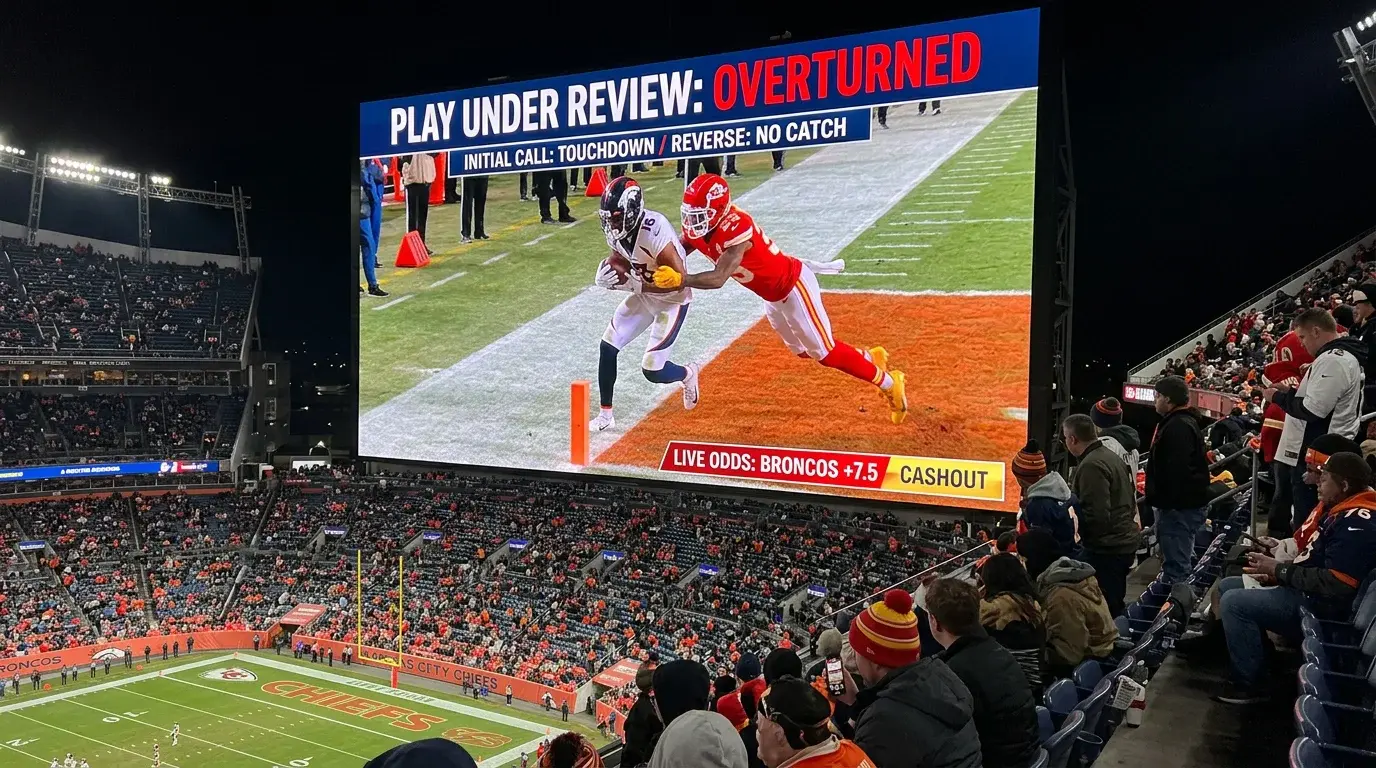
The NFL’s replay review system exists to correct errors in on-field officiating, and it has direct consequences for betting outcomes. The key principle is that bookmakers settle bets based on the official NFL game statistics, not on what the referee initially signalled on the field.
When a touchdown is called on the field and then overturned by replay review, the score is wiped from the record as if it never happened. If your player was credited with a touchdown on the initial call but the review determined he was short of the goal line, stepped out of bounds, or didn’t maintain possession through the catch — that touchdown doesn’t count. Your bet settles as if the play resulted in whatever the corrected ruling was, even if the broadcast showed the celebration and the graphic updated the score.
The reverse scenario also applies, and it’s one that works in your favour. If a play is initially ruled not a touchdown but the replay review overturns the call and awards the score, your player receives a touchdown in the official statistics, and your bet settles as a winner. These “upheld by review” touchdowns are just as valid for betting purposes as any other score.
The timing of replay reviews matters too. In the NFL, all scoring plays are automatically reviewed — coaches don’t need to challenge them. This means every touchdown goes through a review process, even if it’s a perfunctory 15-second check. Occasionally, the on-field crew takes several minutes to reach a decision, and during that window, the broadcast may display conflicting information. What matters for your bet is the final official ruling, which is recorded in the NFL’s game book after the review is complete.
Official NFL Scoring vs Broadcast-Called Touchdowns
A subtlety that catches punters off guard is the gap between what the television broadcast shows and what the official game book records. The broadcast overlay — the score graphic in the corner of the screen — updates in real time based on what the production crew observes. If a touchdown is called on the field, the broadcast score changes immediately. If it’s subsequently overturned, the graphic reverts. But there can be a lag, and in fast-moving games, the broadcast may briefly show a score that the official record doesn’t support.
Bookmakers don’t settle based on what the broadcast showed at any given moment. They wait for the official NFL game statistics, which are compiled by the league’s official statisticians at each game. These statistics are finalised within minutes of the game ending, though minor corrections can occasionally be made in the 24 hours following a game. If a scoring play was particularly controversial or involved a complex review, the league may take slightly longer to confirm the final stat line.
For practical purposes, this means you should check your bets against the official box score rather than relying on what you saw on screen. The NFL’s own website publishes play-by-play data and box scores that reflect the official statistics. If there’s a discrepancy between what you remember watching and what the box score shows, the box score governs how your bet settles.
Stat corrections are rare but they do happen. Occasionally, the NFL reviews game film after the fact and reallocates a statistical credit — for example, determining that a rushing touchdown should actually be classified as a fumble recovery touchdown by a different player. These corrections typically occur within 48 hours of the game, and most bookmakers wait for the correction window to close before finalising settlement on affected markets. This is why some TD scorer bets don’t show as settled in your account until Monday or Tuesday for a Sunday game.
UK Bookmaker Policies on Overturned Touchdowns
The general principle across UK bookmakers is consistent: bets settle based on the official NFL statistics as published by the league. However, the specific language varies between operators, and reading your bookmaker’s rules section is worth the five minutes it takes.
Most UKGC-licensed bookmakers include a clause stating that results are determined by the official governing body of the relevant sport — in this case, the NFL. This means the NFL’s official game book is the final authority, and any disputes about scoring plays are resolved by reference to that document. The UKGC conducted 9,700 compliance actions in the 2024/25 period, more than double the previous year’s figure, reflecting increased regulatory scrutiny of how operators handle settlement and customer disputes. Since February 2025, operators have also faced affordability checks when customers’ net spend exceeds £150 over 30 days, which has further tightened oversight of the entire customer relationship, including how bets are settled.
Since February 2025, UK operators have also faced tighter scrutiny around transparency, including how clearly they communicate settlement rules to customers. If you believe a bet has been settled incorrectly based on the official statistics, you have recourse through the bookmaker’s complaints process and, ultimately, through alternative dispute resolution services approved by the UKGC. In practice, disputes over overturned touchdowns are rare because the NFL’s official statistics are unambiguous — either a player is credited with a touchdown or he isn’t.
One scenario that occasionally generates confusion is when a touchdown is overturned but the same team scores on the very next play. If your player’s touchdown was overturned but he scored again on the subsequent snap, your bet wins — the second touchdown stands as an independent scoring play. If a different player scored on the next play, your original pick still loses. Each play is settled independently, and the narrative arc of “well, they scored anyway” has no bearing on bet settlement. Your pick must be credited with a touchdown in the official scoring records, full stop.