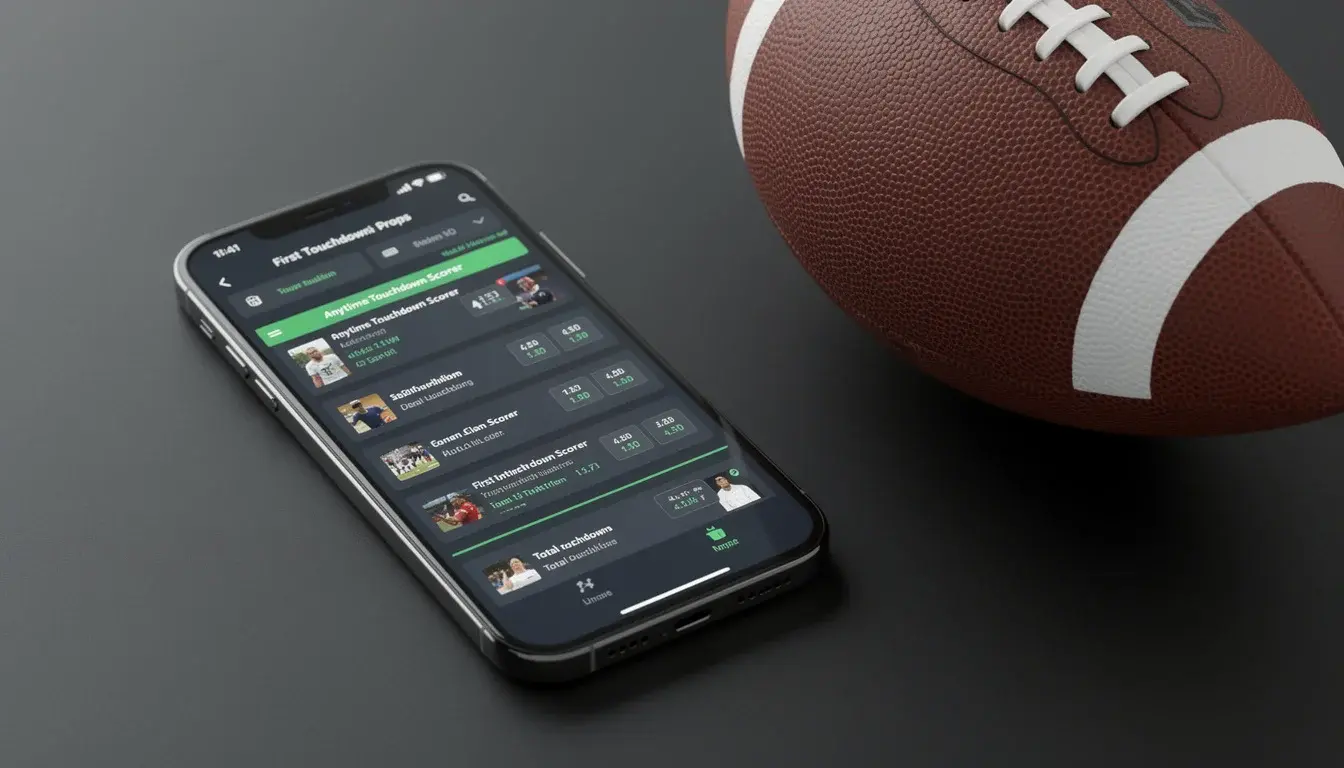

I once watched two punters in the same pub, watching the same game, betting on the same player to score a touchdown – and one of them was getting paid 15% more than the other. Same bet, same outcome, different bookmaker. That’s the reality of touchdown scorer odds: the price you see is not the price everyone else sees, and the gap between the best and worst available odds on a single player can be the difference between long-term profit and long-term loss.
Understanding how odds work isn’t glamorous. Nobody brags about knowing how to convert fractional to decimal. But I’ve tracked TD scorer markets across multiple bookmakers for over a decade, and the punters who consistently find value are the ones who treat odds as a language to be fluent in, not a number to glance at.
Odds Conversion System: Identifying Pricing Ratios and Bookmaker Margins
Every UK bookmaker quotes the same bet in one of three formats – or sometimes all three, depending on your settings. Let me walk through each one using a single example, because seeing the same bet expressed three different ways makes the whole system click.
Imagine you want to bet on a running back to score anytime, and the bookmaker is offering decimal odds of 2.50. Here’s what that means: for every pound you stake, you receive 2.50 pounds back if the bet wins. That includes your original stake. So a 10 pound bet at 2.50 returns 25 pounds total – 10 pounds of your own money plus 15 pounds profit.
The same bet in fractional odds would be listed as 3/2 (spoken as “three to two”). Fractional odds tell you the profit relative to your stake: for every 2 pounds you stake, you profit 3 pounds. Add your stake back and you get the same 25 pounds total return on a 10 pound bet. Fractional odds are the traditional format in the UK, and most high street bookmakers still default to them.
American odds express the same bet as +150. A positive American number tells you how much profit you’d make on a 100 unit stake: +150 means 150 pounds profit on a 100 pound bet. For negative American odds – say, -200 – the number tells you how much you need to stake to profit 100 pounds. American format is standard in the US but rarely used as a default in the UK. You’ll encounter it on US-focused research sites and some international betting tools.
The conversion formulas are simple. Decimal to fractional: subtract 1, then express as a fraction (2.50 – 1 = 1.50 = 3/2). Decimal to American: if decimal is 2.00 or above, American = (decimal – 1) x 100; if below 2.00, American = -100 / (decimal – 1). You don’t need to memorise these – most bookmakers let you toggle formats with a single click – but understanding the relationship helps you think about odds as probabilities rather than arbitrary numbers.
One practical tip: when comparing odds across bookmakers, always compare in decimal format. It’s the most intuitive for direct comparison because the higher number is always the better price. Fractional odds can be misleading when the denominators differ – is 5/2 better or worse than 11/4? (It’s worse. 5/2 = 3.50, 11/4 = 3.75.) Decimal removes the ambiguity.
Implied Probability and Overround for TD Props
Here’s the part that separates casual punters from serious ones. Every set of odds implies a probability – the bookmaker’s estimate of how likely that outcome is, with their margin baked in.
Converting decimal odds to implied probability is one step: divide 1 by the decimal odds, then multiply by 100. At odds of 2.50, the implied probability is 1 / 2.50 = 0.40, or 40%. The bookmaker is pricing that player as having a 40% chance of scoring a touchdown. At odds of 4.00, the implied probability drops to 25%.
But here’s what the bookmaker isn’t telling you: if you add up the implied probabilities of every player in a touchdown scorer market, the total will exceed 100%. It might come to 110%, 115%, or even higher. That excess is the overround – the bookmaker’s built-in margin. It means the odds are systematically shorter (lower) than the true probabilities would dictate. The anytime touchdown scorer market is the most popular player prop by betting volume, which means bookmakers have strong incentives to keep overround high, because volume covers their risk.
A market with a 110% total has a 10% overround. In practical terms, that means you’re paying a 10% tax on every bet you place in that market. To break even long-term in a market with 10% overround, your predictive accuracy needs to be 10% better than the bookmaker’s implied probabilities. That’s a real edge to find – not impossible, but it requires serious analytical work.
Different bookmakers run different overround margins on the same markets. One might price a touchdown scorer market at 108% total, while another runs the same market at 114%. Over a full season of betting, that 6% difference in margin is enormous. It compounds with every bet you place, turning a marginal edge into real profit at one bookmaker and a slow bleed at another.
How to Compare TD Odds Across UK Bookmakers
I compare odds every week during the NFL season. It takes me about fifteen minutes per game, and I’ve never found a shortcut that doesn’t sacrifice accuracy. The UK sports betting market is projected to reach $21.3 billion by 2030, and that growth means more bookmakers competing for your business on NFL props – which is good news for line shoppers.
Start by identifying your target player and market type – say, anytime touchdown scorer for a specific running back. Then check the odds at three or four UK-licensed bookmakers. Write down the decimal odds at each one. The differences are often small (2.40 versus 2.50 versus 2.60), but over a full season of bets, those differences accumulate into meaningful money. On a 10 pound stake, the difference between 2.40 and 2.60 is 2 pounds per winning bet. Multiply that by twenty or thirty winners over a season and you’re looking at 40 to 60 pounds of extra profit just from shopping for better prices.
Some practical considerations when comparing. First, check the rules alongside the odds. A bookmaker offering slightly better odds but excluding overtime touchdowns might actually be a worse deal than a competitor with shorter odds that include OT. Second, account for any odds boosts or promotions – a temporary boost on a specific player can make one bookmaker’s price dramatically better than the rest, but only for that single bet. Third, consider how quickly each bookmaker updates their odds. Some adjust lines rapidly in response to injury news; others are slower. If you spot a key injury before a bookmaker has adjusted their odds, you might find a temporarily inflated price that represents genuine value.
The bottom line is this: every odds comparison you do is a small act of due diligence that tilts the long-term maths slightly more in your favour. No single comparison will make or break your season. But the habit of comparing, week after week, is one of the clearest edges available to UK punters who take NFL touchdown betting seriously. If you want to go deeper into the mechanics of how bookmakers set these prices, understanding how different UK bookmakers approach NFL markets is a natural next step.