

I remember my first NFL touchdown bet. It was a Thursday night game, I picked a running back I’d never watched play, and I lost. Not because the bet was bad in theory – I just had no framework, no process, and no idea what I was doing. That was over a decade ago, and I’ve spent every season since then studying how touchdown scoring actually works in the NFL and how UK punters can approach this market without burning through their bankroll in Week 1.
The NFL has 13 million fans in the UK, and that number keeps climbing. More British punters are discovering touchdown scorer bets every season, drawn in by the simplicity of the concept: pick a player, hope he scores. But simplicity on the surface hides real complexity underneath, and the gap between casual punters and those who consistently find value is almost always about preparation. Around 10% of the UK population now bets on sports online, so the appetite is clearly there – the question is whether you’re feeding it wisely.
This guide is the one I wish I’d had when I started. No jargon overload, no pressure, just the practical steps and honest warnings that will help you place smarter touchdown bets from your very first wager.
Market Entry System: Selection Rules and Account Placement Parameters
The first time I walked a friend through placing a TD bet, he spent twenty minutes staring at the screen trying to figure out where the market even was. So let me save you that confusion. Here’s exactly how the process works, from opening your bookmaker account to watching the result come in.
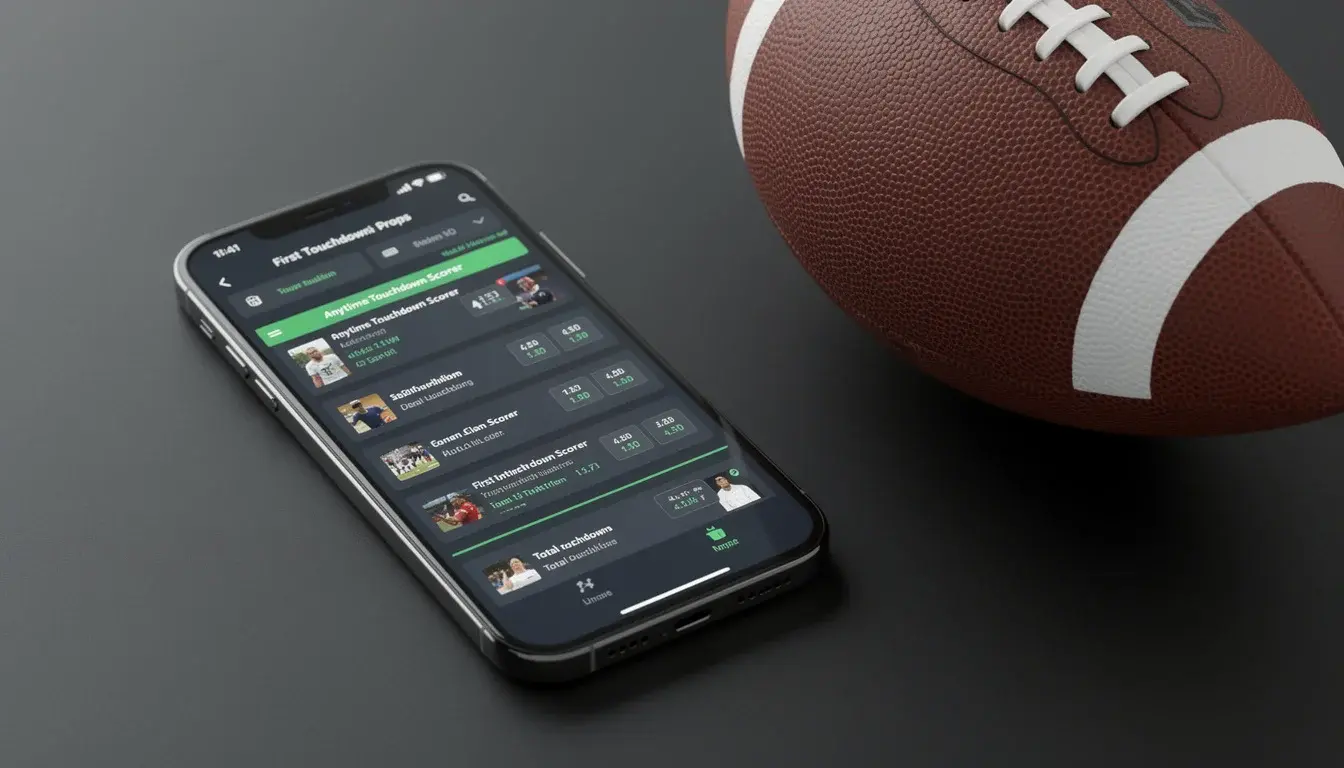
Start by logging into a UK-licensed bookmaker that offers NFL player props. Navigate to “American Football” or “NFL” in the sports menu, then find the game you want to bet on. Within each game, look for “Player Props” or “Touchdown Scorer” – the exact label varies by bookmaker, but the market is always nested under the specific match, not under a general NFL tab.
Once you’re in the touchdown scorer section, you’ll see three main market types. The anytime touchdown scorer market is the one I recommend for beginners: you pick a player, and if he scores a touchdown at any point during the game, you win. It doesn’t matter whether he scores in the first quarter or the last – any touchdown counts. First touchdown scorer is a different beast entirely, requiring your player to score the game’s very first TD, which naturally carries much longer odds. Last touchdown scorer works the same way but for the final TD of the game.
Select the player you want to back, and his odds will appear on your bet slip. If you see decimal odds of 2.50, that means a 10 pound stake returns 25 pounds total (your 10 pound stake plus 15 pounds profit). Fractional odds of 3/2 mean the same thing – for every 2 pounds you stake, you profit 3. Most UK bookmakers default to fractional odds, but you can switch formats in your account settings.
Before confirming, double-check three things: the player’s name is correct (autocomplete has cost me more than one bet), the stake amount is what you intended, and the market type matches what you want. Then confirm the bet and wait for kickoff.
One detail that trips up every beginner: a quarterback who throws a touchdown pass does not count as the touchdown scorer. The scorer is the player who physically carries or catches the ball into the end zone. A QB only counts as a touchdown scorer if he runs the ball in himself. This single rule is responsible for more confused beginners than any other aspect of the market, so tattoo it on your brain before you place anything.
After the game, settlement is usually automatic. If your player scored, winnings land in your account within minutes. If the game goes to overtime, most UK bookmakers still count those touchdowns for anytime scorer bets – but check your bookmaker’s specific rules, because this is one area where policies can differ.
Five Beginner Mistakes to Avoid
I’ve made every single one of these mistakes, most of them more than once. The good news is that recognising them early saves you real money. The bad news is that they’re seductive – each one feels rational until you see the results.
The first mistake is chasing big names. Every beginner wants to pick the superstar – the player they’ve heard of on Sky Sports or seen in a highlight reel. But star recognition and touchdown probability are two different things. A backup running back who gets all the goal-line carries in a run-heavy offence will outscore a famous wide receiver who rarely sees red zone targets. Popularity is noise; usage data is signal.
Second: ignoring the matchup. A running back who averages a touchdown per game sounds like a lock, until you realise this week he’s facing a defence that hasn’t allowed a rushing touchdown in six games. Every touchdown bet is a two-sided equation – the player’s scoring ability and the defence’s ability to prevent it. Skip the defensive side, and you’re betting with one eye closed.
Third: betting too many games at once. When you’re starting out, the temptation is to put a touchdown pick on every game of the week. That’s sixteen chances to win, right? It’s also sixteen chances to lose, and spreading your attention that thin means you’re not properly researching any of them. I’d rather place two well-researched bets than twelve guesses. As one analyst group put it, extended cold streaks are a real possibility when dealing with longer odds, so managing your bankroll accordingly matters more than volume.
Fourth: confusing probability with certainty. A player with -150 odds (about 1.67 decimal) to score anytime is the favourite for a reason, but “favourite” still means he fails to score roughly 40% of the time. Touchdown scoring is inherently volatile – even the most prolific scorers have dry weeks. If you treat any single bet as a guaranteed win, you’ll overcommit your stake and feel the loss much harder than you should.
Fifth: not checking whether your player is actually playing. This sounds obvious, but late scratches happen constantly in the NFL. A player listed as “questionable” on Friday might be ruled out thirty minutes before kickoff. If you placed your bet on Tuesday and didn’t check the injury report on Sunday morning, you could be holding a dead ticket. Some bookmakers void bets on inactive players, others don’t – and the difference matters.
A Low-Risk Approach for Your First NFL TD Bets
If I could go back and give myself one piece of advice before my first season of touchdown betting, it would be this: start with anytime touchdown scorer singles on running backs who get goal-line work, and keep your stakes small enough that losing feels like a lesson, not a disaster.
Here’s why this works as a starting framework. Running backs with consistent red zone carries have the most predictable path to scoring. Nearly 87% of all rushing touchdowns in the NFL come from inside the red zone, and over 23% of all touchdowns are scored from the one- or two-yard line. That means a running back who regularly lines up in short-yardage situations has a structurally higher chance of scoring than a wide receiver who needs a specific play design to get the ball near the end zone.
For your first few weeks, pick one or two games per week – ideally games you’re actually going to watch, because watching teaches you more than any spreadsheet. Focus on the anytime market rather than first TD, because anytime gives you the full sixty minutes of game time for your player to score. The odds are shorter, but your win rate will be meaningfully higher, and early wins build both confidence and understanding.
Set a fixed stake for each bet – the same amount every time. I started with 2% of my bankroll per bet, which meant I could absorb twenty consecutive losses before running out. That sounds extreme, but it gave me the psychological breathing room to make decisions based on analysis rather than desperation. If you’re starting with a 100 pound bankroll, that’s 2 pounds per bet. Not glamorous, but sustainable.
Keep a simple record of every bet: the player, the matchup, the odds, the stake, and the result. After four or five weeks, patterns emerge. You’ll notice which types of picks hit, which ones miss, and – most importantly – whether your reasoning was sound even when the result went against you. That feedback loop is the difference between someone who bets on touchdowns and someone who actually gets better at it.
And one more thing: enjoy it. The NFL season is seventeen weeks of regular season plus playoffs, and if you spend every Sunday clenched with anxiety over a two-pound bet, you’re doing it wrong. Touchdown betting should make watching the games more engaging, not less. The moment it stops being fun, step back and reassess. There’s always next week, and there’s always a deeper strategy waiting when you’re ready for it.