
There’s nothing quite like watching an NFL game live in London. The atmosphere is electric, the crowd is a mix of die-hard fans in obscure jerseys and newcomers discovering the sport for the first time, and the stakes feel different when the action is happening in your own time zone. Since the NFL started staging regular-season games in the UK back in 2007, these London fixtures have become a highlight of the calendar for British punters — and they present some genuinely unique angles for touchdown betting.
London games aren’t just regular-season games that happen to be played abroad. The travel factor, the unfamiliar environment, the scheduling quirks, and the crowd dynamics all contribute to scoring patterns that diverge from the league-wide norm. Over 39 regular-season games played in the UK through the 2025 season, enough data has accumulated to identify real trends — and smart TD prop bettors can use them.
International Series Trends: Travel Fatigue and Stadium Environment Analytics
The first question every punter asks about London games is whether they produce more or fewer touchdowns than typical NFL fixtures. The answer is more complicated than a simple directional tilt, because London games show wider variance rather than a consistent lean one way.
What the data does show is a tendency toward lopsided scoring. London games produce a disproportionate number of blowouts compared to the league average. One theory is that the travel and schedule disruption affect one team more than the other, creating a performance gap that widens as the game progresses. For touchdown bettors, this matters because blowouts change the scoring distribution. The leading team runs the ball more in the second half to burn clock, which inflates running back touchdown opportunities. The trailing team passes aggressively in catch-up mode, boosting wide receiver TD chances but also increasing the risk of turnovers and drives that stall without scoring.
International NFL games drew record viewership in 2025, averaging 6.2 million viewers across television and digital platforms — a 32% increase over the previous season. That growth reflects the NFL’s deep investment in international expansion, and it brings sharper market attention to London fixtures. UK bookmakers now offer London games the same depth of TD prop coverage as any domestic fixture, which wasn’t always the case even a few years ago.
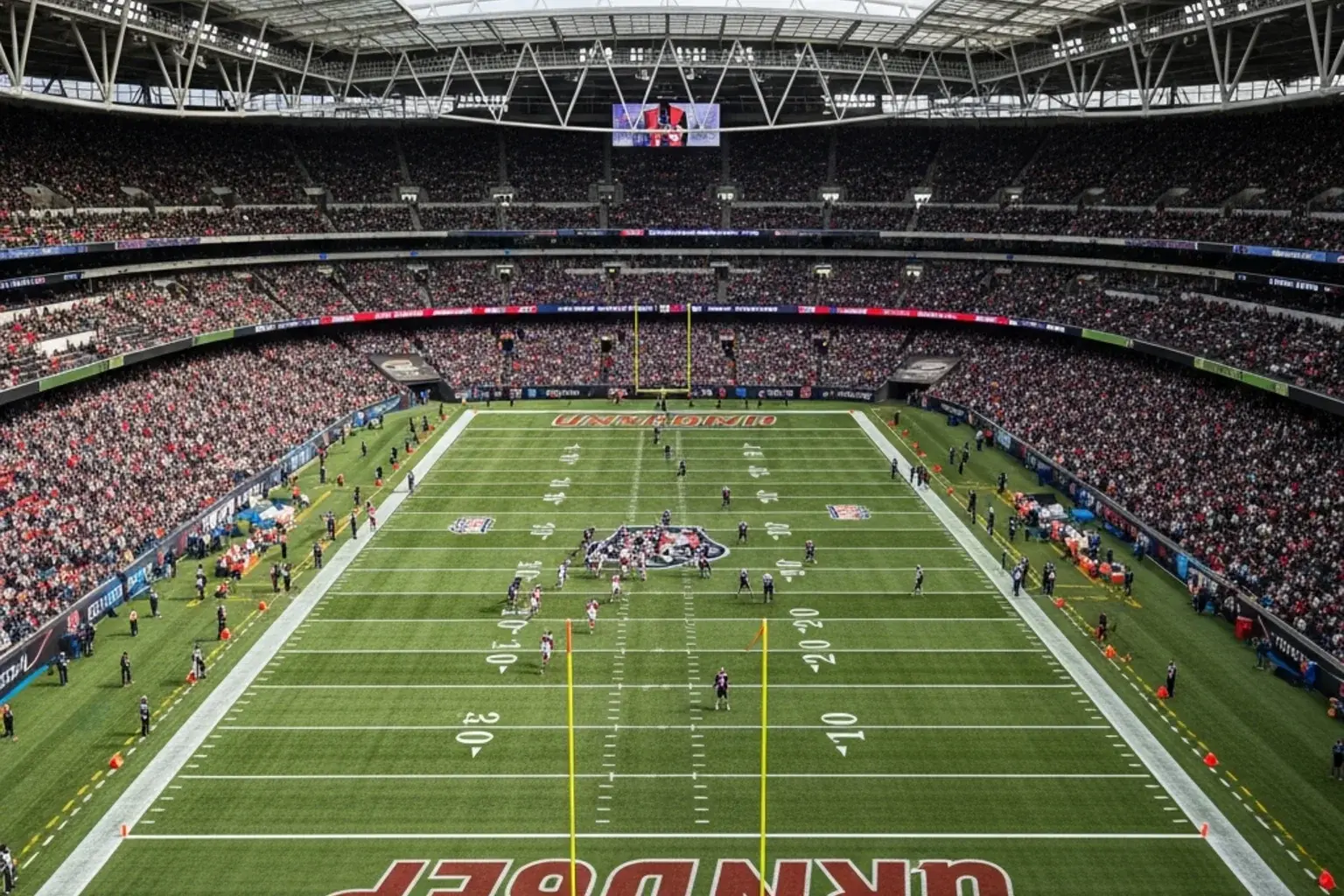
The record attendance figure tells its own story — 86,651 fans packed Wembley for Jacksonville versus New England in 2025, the highest turnout for a London NFL game ever. That kind of crowd energy can genuinely affect momentum swings, and it introduces a home-field-like advantage for teams with large UK followings, though measuring that impact precisely remains difficult.
How Travel and Time Zones Affect Team Performance
Every conversation about London game strategy eventually comes back to travel. American NFL teams are crossing the Atlantic, adjusting to a five-to-eight-hour time difference, and often arriving just days before kickoff. The impact on physical readiness and game planning is real, though teams have become more sophisticated in managing it over the years.
The key variable is how each team handles the logistics. Some franchises arrive early in the week, train at local facilities, and treat the trip as a bonding experience. Others fly in as late as possible to minimise disruption to their routine. Minnesota Vikings owner Mark Wilf captured the evolving attitude when discussing the team’s 2025 London appearance, noting that UK fans have a history of showing up and embracing the Vikings, and that returning to play internationally was an opportunity the franchise actively sought.
For touchdown betting purposes, the travel factor creates an asymmetry worth tracking. West Coast teams face the most severe time adjustment — they’re shifting eight hours forward, which can disrupt sleep patterns and circadian rhythms. East Coast teams face a smaller adjustment and historically perform closer to their domestic baseline. If you’re comparing two teams in a London fixture and one is based on the West Coast while the other sits on the Eastern seaboard, that travel differential is a legitimate factor in your analysis.
Bye-week placement matters too. Teams scheduled for a bye week immediately after a London game can prepare more aggressively, knowing their players will have extra recovery time. Teams that fly back to the US and play again the following Sunday sometimes show fatigue effects that bleed into the next game’s scoring. For the London game itself, a team with a post-London bye may rotate starters more freely, which can affect late-game touchdown distribution.
Touchdown Betting Angles for London Games
Putting the trends together, a few actionable angles emerge for TD props in London fixtures.
First, lean toward established, high-volume scorers rather than speculative picks. London games introduce extra uncertainty — unfamiliar turf, different crowd noise, jet lag — and that uncertainty rewards players whose role is secure regardless of conditions. A team’s primary running back and top red zone target are less affected by travel disruption than a depth receiver whose involvement fluctuates week to week. If a team’s featured back gets 20-plus carries per game, his workload is unlikely to drop in London even if the passing game stutters.
Second, consider the underdog’s passing options for value. As mentioned, London blowouts are more common than average, and the trailing team throws heavily in the second half. If you identify a game where one team is a significant underdog, their top wide receiver may carry outsized value as a last TD scorer or anytime scorer pick. The odds on that player often reflect his season averages rather than the elevated passing volume a large deficit would create.
Third, watch for UK-specific promotions around London games. British bookmakers frequently boost odds or offer enhanced markets for these fixtures, recognising the heightened interest from their customer base. These promotions don’t change the underlying probability, but they can shift the expected value equation in your favour if the boosted odds exceed what the matchup data suggests is fair.
Finally, treat London games as events where your usual data needs a small adjustment, not a complete overhaul. The teams are still the same rosters playing under the same rules. The travel and environment factors are real but secondary to the fundamental matchup. A running back averaging 1.2 touchdowns per game against a weak run defence doesn’t become a bad pick just because the game is at Tottenham Hotspur Stadium. He’s still a strong pick — you just want to confirm that the logistics haven’t produced any unusual rest or preparation issues that might affect his workload.