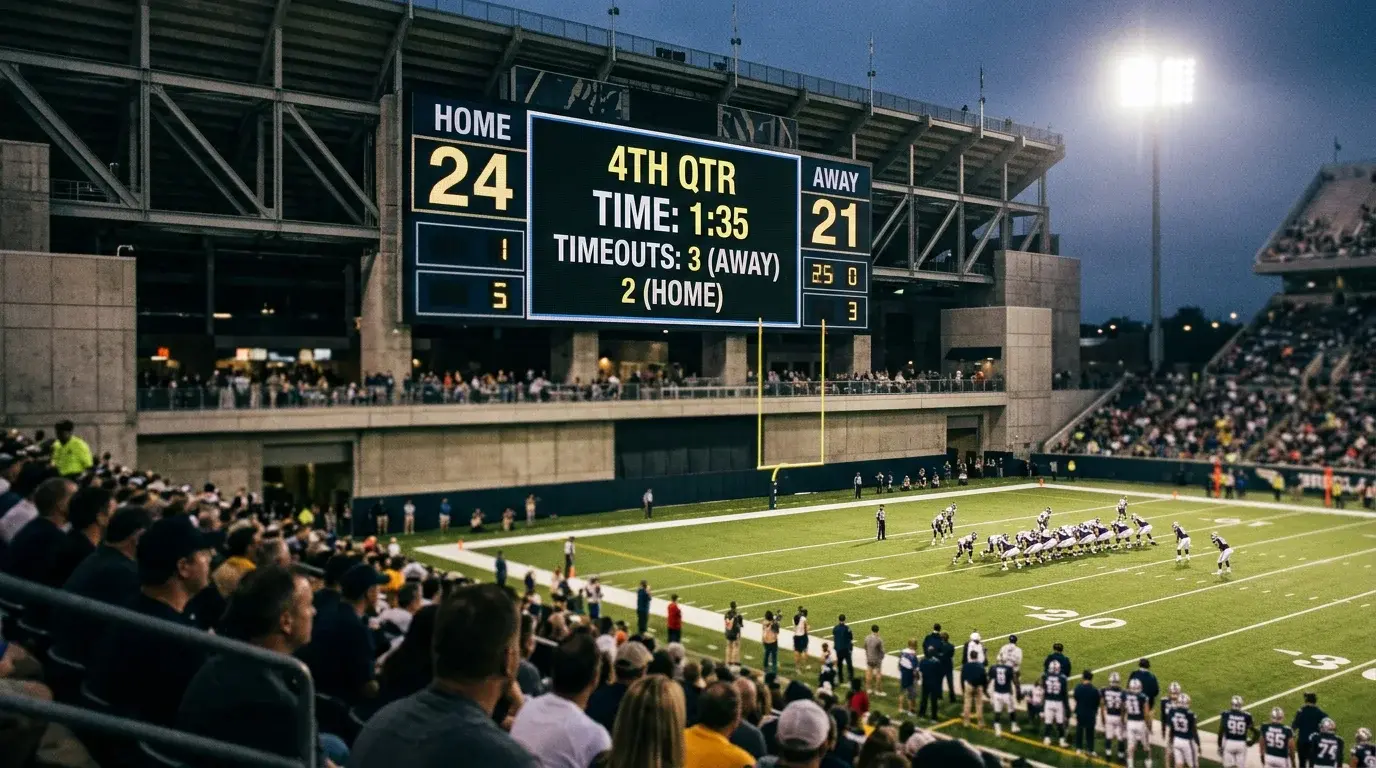


One of the first shortcuts I developed for screening TD props was simple: sort Sunday’s slate by the over/under total and start my analysis with the highest-scoring projected games. The logic felt obvious — more expected points means more expected touchdowns, which means more opportunities for my picks to cash. It turns out that logic is broadly correct, but the relationship between game totals and touchdown frequency is more nuanced than a straight line, and understanding where it bends is where the real edge sits.
The game total, or over/under, is the market’s consensus estimate of total points scored by both teams. It reflects everything the oddsmakers know about the matchup — offensive quality, defensive quality, pace, weather, and game script. Because touchdowns account for the vast majority of NFL scoring, the total is effectively a proxy for expected touchdown volume. But it’s an imperfect proxy, and the gaps between “expected total points” and “expected individual touchdowns” create opportunities for alert punters.
Over/Under Correlations: Using Market Points Lines to Target Scorer Picks
The maths connecting game totals to touchdowns is straightforward at a high level. In a typical NFL game, roughly 74% of all touchdowns come from inside the red zone, with the rest arriving via long plays — breakaway runs, deep passes, and defensive or special teams scores. The average NFL game produces between 4.5 and 5.5 touchdowns, depending on the season and the specific matchups involved.
When a game total is set at 50 or higher, the market is projecting an above-average scoring environment. That projection translates into more possessions reaching the red zone, more red zone conversions, and more total touchdowns. Games with totals above 50 average roughly 6-7 touchdowns, while games with totals below 40 average closer to 3.5-4.5. That difference of two to three touchdowns across a game significantly shifts the probability that any individual player scores.
The relationship isn’t perfectly linear, though. The jump from a 42-total game to a 46-total game produces a larger increase in expected touchdowns than the jump from 50 to 54. In lower-scoring games, each additional expected point is more likely to come via touchdowns rather than field goals, because defences in those matchups tend to force field goal attempts more often. In high-scoring games, the marginal points are more evenly distributed between touchdowns and extra points. This means the “sweet spot” for TD prop purposes sits in the 46-52 range, where the total is high enough to project elevated scoring but not so high that the market has already priced in the inflated touchdown probability across all the available odds.
Football accounts for roughly 34% of all US sports betting handle, and the NFL’s dominance means that game totals are among the sharpest lines in the market. The total itself is difficult to beat — bookmakers have decades of data and sophisticated models behind their numbers. But the connection between the total and individual TD prop prices is less efficiently priced, because bookmakers set player props using models that don’t always fully account for game-environment variables like total.
How to Use High-Total Games for TD Picks
When I see a game total at 50 or above, my approach shifts in two specific ways. First, I expand the pool of viable TD picks beyond the obvious primary scorers. In a game projected for 6-7 touchdowns, there are enough scoring opportunities that secondary options — the number-two receiver, the change-of-pace back, the pass-catching tight end — carry meaningful probability. Their odds often remain at pre-season levels or are slow to adjust to the elevated game environment, which creates value.
Elite red zone offences paired with weak red zone defences are the strongest indicator of individual scoring in high-total games. A team with a 65% or higher red zone touchdown conversion rate that projects to reach the red zone 4-5 times creates a target-rich environment. The team’s top two scoring options in those situations — typically the featured running back and the primary red zone receiving threat — are both viable picks, and backing both as anytime scorers in the same game is a reasonable strategy when the odds support it.
Second, I pay closer attention to the spread in conjunction with the total. A game with a total of 52 and a spread of 3 projects a close, high-scoring contest where both offences contribute roughly equally. That’s different from a 52-total game with a 14-point spread, where the favourite is expected to score the majority of points while the underdog’s total is suppressed. In the close, high-total game, both teams’ TD options are viable. In the lopsided version, focus your picks on the favourite’s goal-line back and the underdog’s red zone passing targets, who benefit from the trailing team’s increased passing volume.
Low-Total Games: Traps and Opportunities
Low-total games — those with an over/under below 40 — are where most TD prop bettors lose money, because the instinct is to avoid them entirely. That instinct is partially right but partially wrong, and the distinction matters.
The trap in low-total games is backing skill-position players at their standard odds without adjusting for the reduced scoring environment. A wide receiver priced at 2.80 in a 48-total game may be worth backing, but that same player at the same odds in a 37-total game is a poor bet. The scoring opportunities are compressed, and the probability of any individual player finding the end zone drops materially. If you’re going to bet TD props in low-total games, your estimated true probability must exceed the implied probability by a wider margin than usual to compensate for the reduced opportunity.
The opportunity in low-total games sits with goal-line running backs and short-yardage specialists. When teams do score in these environments, the touchdowns disproportionately come from the ground — specifically from inside the 5-yard line. The low total reflects compressed passing games, conservative play-calling, and defensive dominance, all of which funnel scoring toward power running at the goal line. A running back who handles 80% or more of his team’s goal-line carries becomes the primary beneficiary of every red zone trip, and in a game where there may only be two or three such trips, he’s the one most likely to convert.
The discipline in low-total games is to bet fewer picks at lower stakes. This isn’t the environment for a four-leg TD scorer parlay — the probability of multiple players scoring shrinks dramatically. One carefully selected running back, at odds that reflect genuine value rather than standard pricing, is the right play. Everything else is a pass.