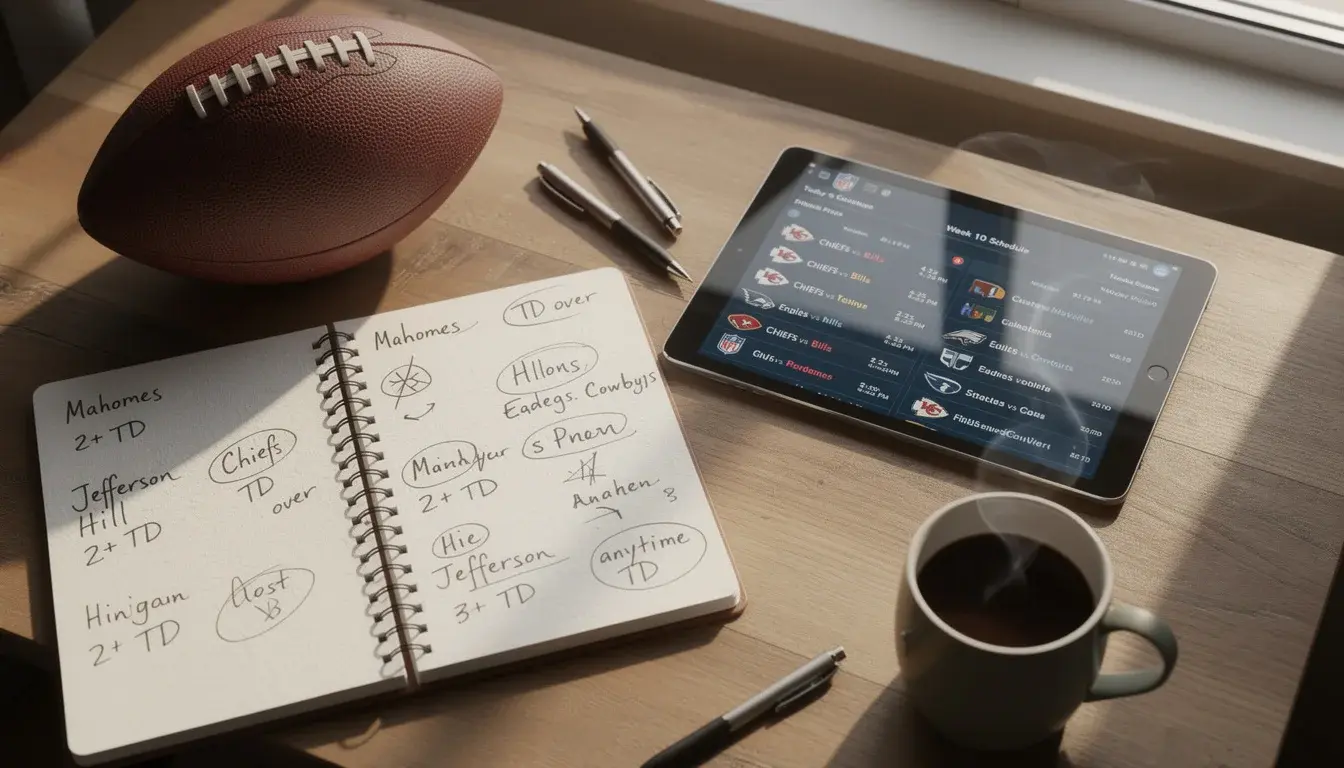
Every Tuesday morning during the NFL season, I sit down with a cup of coffee and a blank spreadsheet. By Wednesday evening, I’ve narrowed sixteen games down to two or three touchdown picks I’m genuinely confident about. The process hasn’t changed much in twelve years – the data sources have improved, the bookmaker platforms have gotten faster, but the core framework is the same. And it’s a framework anyone can replicate, which is the entire point of this article.
I’m not going to give you this week’s picks. Picks without context are useless, because by the time you read them, the lines have moved, the injury landscape has shifted, and the reasoning behind the selection may no longer apply. What I’m giving you instead is the system I use to generate my own picks every single week – the same system that’s kept me profitable across multiple seasons in a market where projected NFL betting handle for the 2025 season alone reached 30 billion dollars through licensed US operators.
Screening Criteria for This Week’s Touchdown Picks
Here’s the filter I run every week. It’s not complicated, but it’s rigorous, and the discipline of applying it consistently is what separates a repeatable process from random guessing.
First filter: red zone volume. I want players who are seeing at least three red zone opportunities per game over the past three weeks. This isn’t a hard cutoff – context matters – but a player averaging one red zone touch per game needs an extraordinary matchup to justify a touchdown bet. Volume is the foundation. Without it, you’re relying on big plays and luck, neither of which is a sustainable betting strategy.
Second filter: defensive matchup. I look at the opposing defence’s red zone touchdown rate allowed – how often do teams score touchdowns (not field goals) when they reach this defence’s red zone? A defence allowing a 65% or higher red zone TD rate is a favourable matchup. Below 50% is a warning sign. The 2025 Denver Broncos were a prime example of the latter – the only team holding opponents below a 50% red zone TD rate – and fading offensive players against them was consistently profitable.
Third filter: game total. The Vegas over/under on a game gives you a market-consensus estimate of total scoring. Games with totals of 48 or higher generally produce more touchdown opportunities than games projected at 38. I don’t bet on touchdown scorers in games with totals below 40 unless I have a very specific reason.
Fourth filter: player health and usage trend. Is the player’s snap count increasing, decreasing, or stable? A player who saw 80% of snaps two weeks ago but dropped to 55% last week might be losing playing time to a committee approach. Conversely, a player whose snap count jumped from 50% to 75% might be taking over a larger role. Trends over three weeks tell a clearer story than any single week’s number.
After running these four filters, I typically have five to eight players left. From there, I compare the bookmaker odds on each one to my estimated probability of them scoring, and I bet only on players where the odds imply a lower probability than my analysis suggests. That gap between my estimate and the bookmaker’s price is where value lives.
When to Place Your Bets: Timing and Line Movement
I used to place all my bets on Sunday morning, an hour before kickoff. Then I started tracking when the odds moved most dramatically, and I changed my approach entirely.
Touchdown scorer lines at UK bookmakers typically open on Tuesday or Wednesday for the following week’s games. Early-week prices are set with less information – injury reports haven’t been fully released, and the market hasn’t had time to sharpen the lines through betting volume. This means early-week odds can sometimes be softer than game-day odds, particularly for players whose status is uncertain.
The sharpest line movement happens between Friday evening and Sunday morning. That’s when the final injury reports are published, when sharp bettors place their largest wagers, and when bookmakers adjust their prices most aggressively. If a key player is ruled out on Friday afternoon, his backup’s touchdown odds will shorten dramatically by Saturday morning as the market reacts.
My approach: I identify my targets mid-week and place bets on Thursday or Friday for players whose status is clear and whose odds I believe represent value. For players with uncertain injury status, I wait until the final report confirms they’re active, then place the bet as quickly as possible before the line adjusts. Consistently beating the closing line – the final odds available before a game starts – is one of the strongest indicators that your analysis contains genuine insight the broader market hasn’t yet priced in.
One word of caution about timing: don’t confuse early access with an edge. Placing a bet on Tuesday doesn’t automatically mean you’re getting better odds. Sometimes Tuesday prices are longer because the bookmaker hasn’t received much betting volume and is offering wider margins to manage risk. Other times, Tuesday prices are shorter because the bookmaker has set a conservative opening line. The question isn’t when you bet – it’s whether the price you’re getting reflects value relative to your analysis. If you want a structured approach to building that analysis week after week, the anytime touchdown scorer strategy framework breaks down each step in detail.